Dutch National Ballet Program B Review
November 21, 2025 | New York City Center – New York, NY, USA
Ballet companies nowadays present programs designed to appeal to everyone as opposed to showcasing a single repertory staple, such as The Sleeping Beauty.
This trend overpacking a program with a diverse bundle of dances, perhaps is also a way to boost ticket sales. But in doing so, companies, like the renowned Dutch National Ballet, are steering away from presenting the masterpieces that I so desperately crave.
You may also like...
Birmingham Royal Ballet The Nutcracker Review: Magical Traditions Live On
Birmingham Royal Ballet The Nutcracker Review: The company's strong technical abilities and storytelling skills is bolstered by the rich costume and scenic design to deliver a production that delights.
Dutch National Ballet Program A Review: A Mixed Bag Instead of A Mixed Bill
Dutch National Ballet Program A Review: Despite the works with accompaniment being the strongest, they were still overshadowed by a disjointed program.
Dutch National Ballet Program B Review
Their recent quadruple-bill at New York City Center had a glacial beginning that gradually developed into a flaming finish. And had I arrived in a mink coat, I’d certainly be shedding it as the night progressed.
From an icy sextet, a Neolithic duet, the Wings of Wax, to five sultry tangos, the evening was carefully curated to build in intensity; but ultimately, the contrasts fragmented what could have been a cohesive experience.
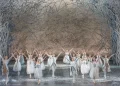
Adagio Hammerklavier by Hans van Manen, music by Ludwig van Beethoven, opened the show. Known for creating works of “refined simplicity”, Manen choreographed Adagio back in 1973, a work essentially about three couples exploring ways to embody distilled serenity, resembling sparkling crystals floating beside the vast arctic.
The ensemble’s angular lines mimicking icicles, hands and arms pushing away space as if also warding off warmth, the overall effect was minimally modern and quite refreshing.
The dance also calls to mind Antony Tudor’s sextet Continuo, which was also choreographed in the 70s, sharing Adagio’s purity and form.
Amongst the cast, principal dancer Olga Smirnova stood out the most with her Bolshoi-trained legs and feet, dancing softer than the rest, the adagio even more at ease in her luminous white dress.
A few Adagio aspects didn’t quite work for me: the projected video of a dark blue curtain felt out of place; Jean-Paul Vroom’s costumes for the men – bare-chested wearing only diamond chokers leaned a bit too Chippendales; and some of the partnering phrases were overly repetitive.
Next, Mthuthuzeli November’s U.S. premiere of Thando, which he both choreographed and composed, felt too forced. Despite the full commitment of principal dancers Anna Tsygankova and Giorgi Potskhishvili, the earthy duet read more like an episode of Survivor than fireworks.
The dance opened in silence with Tsygankova in a nude-colored leotard, trying to be fierce, flapping her arms like a wild bird before a Tarzan-like Potskhishvili entered, twisting her into splits and weaving through her limbs.
His raw, breath-heavy movement and her brief violin solo added intensity, but the choreography was ultimately more awkward than awe inspiring. As the tribal drums and chanting accelerated, the dancers seemed both over-zealous and lost in their own jungle until they finally slid offstage.
Jiří Kylián’s Wings of Wax (1997) was the highlight of the evening, a work of abstract art that also can belong in a museum.
Inspired by the myth of Icarus, the main message was: Be careful in intimate relationships; when your wings are no longer wax but something more durable, then it is safe to approach.
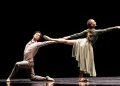
Unlike Manen’s Adagio, Wings of Wax never repeated itself and creativity overflowed, proving that Kylián is the king in crafting contemporary pas de deux.
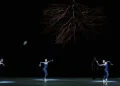
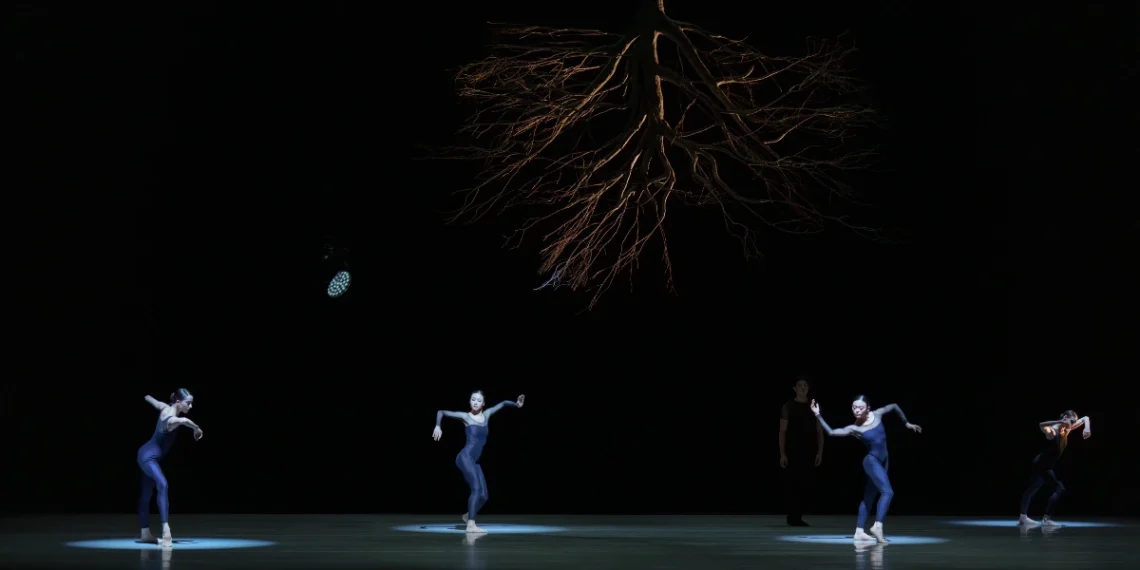
The stage opened on Michael Simon’s upside-down leafless tree with a spotlight circumventing it.
The fusion of Biber, Cage, Glass, and Bach’s music only enhanced Kylián’s extraordinarily precise choreography; every leap, slide, and battement syncs every accent in the score.
One by one, eight dancers emerged from behind a black curtain, entering a dreamlike landscape, moving like ravens in a desolate world, lifting one another under the shoulders, sliding with trembling hands, or manipulating partners like marionettes. These movements echo some of Kylián’s other works à la Petite Mort and Sweet Dreams.
While the partnering work grew increasingly complex, the men continued to deliver virtuosic solos where their bold physicality contrasted the women’s delicate fluidities.
Smirnova returned for the final pas, her body vibrating before softening into some sustained movements, transforming herself into a contemporary dancer as she motioned into every musical “ding.”
The dance closed with an endless fading embrace between Smironova and Timothy van Poucke, seven times to be exact. It was undoubtedly my favorite moment of the night.
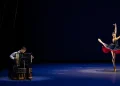
Manen’s other piece, 5 Tangos, closed the evening, set to Astor Piazzolla’s classic tangos that evoked mystery and sophistication, making me want to enroll in a tango lesson afterward. Also a 70s ballet, the work experimented with how to tango en pointe.
The stage opened in silence with six couples in a line, hands flexed, moving into swirling patterns and deep backbends in formal attire.
The most striking section featured Maia Makhateli at center stage, kneeling and parading alone as a group of men mirrored her movements. She was lifted, passed between partners, and held aloft in a commanding “V” pose before they set her down, covering her up like a magic trick, a moment of her clear power and dominance.
Subsequent duets and group dances blended unison leaps, promenades, and tango-inspired movements, with the women flicking their arms, elongating their arabesques, and the men twisting sharply with the accordion music.
The ensemble returned for a final group tango, slowing down to show off some sensual walks, port de bras, regrouped in two lines at center stage before breaking apart one by one as the music faded, and ending in a final pose that resembles a ballroom dance studio logo.
Although the show was eclectically serene and sizzling, its dramatic differences between the pieces didn’t hold a lasting impact, and I’d much prefer to have seen a full-length ballet with one central focus instead.
I want to be wowed every time I go to the ballet, yet it seems like masterful full-length concerts are increasingly rare these days. Hopefully more ballet companies will showcase what they do best (some tutus might help, especially at prestigious venues) and save their experimental ballets for smaller gatherings.
Featured Photo of Dutch National Ballet dancers in Jiří Kylián’s Wings of Wax. Photo ©Altin Kaftira, courtesy of New York City Center.