


English National Ballet Giselle Review
January 15, 2026 | London Coliseum – London, England
Even glimpses at trailers of this ballet, now celebrating its 10th year since creation, are spine-tingling, and my anticipation is rewarded the minute a loud rumbling and crackling fills the auditorium on opening night, as we sink into darkness.
“Set in a divided world of migrant outcasts and exploitative landlords, this bold reimagining of the romantic classic isn’t just something you watch, it’s something you feel.”
Before they’d even moved, the outcasts’ hands against the handprints on the huge wall screamed unspoken emotion. A strong sense of both brokenness and togetherness hung about their group.
There’s a sense of danger from the outset.
Skilful choreography by Akram Khan assisted by Andrej Petrovič, intimidating set design (Tim Yip), both shadowy and stark lighting (Mark Henderson) and evocative orchestration (Vincenzo Lamagna, Gavin Sutherland) all collaborating to sustain the tension throughout.
You may also like...
Joshua Beamish/MOVETHECOMPANY Review: In Solos & Duets, a Solo Rises to the Top
Joshua Beamish/MOVETHECOMPANY Review: The choreography for Lost Touch feels clean, intentional, complete - a cue for the possibilities ahead in Vancouver.
Birmingham Royal Ballet Nutcracker Review: A Cinematic Delight at Royal Albert Hall
Birmingham Royal Ballet Nutcracker Review: Technical talent and impressive theatrical prowess make for an immersive and inspiring experience in this unique space.
English National Ballet Giselle Review
I’m a huge fan of the nineteenth century classic Giselle by Jean Coralli and Jules Perrot and it’s thrilling to hear snatches of the original music by Adolphe Adams incorporated into this deeply emotional, effectively oppressive modern score.
And it is satisfying to see references to that original choreography; for example the iconic arabesque hops across the stage in opposing crossover lines.
The choreography was used cleverly in places to convey messages.
Giselle began a wave-like movement through her body that was picked up on by the other outcasts who were soon moving as one sea together. Albrecht, attempting to fit in, tried to emulate their movement, but remained an outsider.
Another standout moment for me was the embodiment of the factory machinery via powerful blended movement of the outcasts in two vertical lines. Visually stunning, but deeper than that, they demonstrated invisibility, loss of individuality in their underworld as they moved together – Albrecht was unable to locate Giselle among the group.
Whether intentional or not, I sensed that Albrecht was more the pursuer of Giselle than she of him. I’d have loved to see her love and need for him a little more, though their sensual duet was playful and a delight to watch.
I was waiting for the dramatic contrast from Act I to Act II as is highly palpable in the original. Though it didn’t disappoint, the contrast in this production was not the same as the joyful village scene into the ghostly woods of the Coralli/Perrot Giselle.
The underlying theme of dark danger and oppression lingered here throughout both acts, rather than a wild variance between the two.
It felt as though there were lessons to be learned as we watched the landlords aloof, observing scenes of distress and intimidation and remaining detached.
And Albrecht of course, danced tonight by James Streeter, carried the weight of the heaviest caution on his shoulders – being dealt intense comeuppance for hiding his identity to feed his selfish desires, and ultimately losing all that was dear to him in the end.
A small observation due to the dark lighting which was nonetheless incredibly effective; facial expressions particularly for Albrecht and Giselle were a little hard to decipher.
Giselle, danced tonight by Emily Suzuki, had so much to offer this role.
She was joyful and light initially, but with an underlying steady confidence and determination that our nineteenth century Giselle perhaps did not possess.
I’d like to have seen more of the madness scene rather than her remaining hidden for the majority, though the wave-like circling of the outcasts around her was exciting.
Hilarion, danced by Ken Saruhashi, was bursting with passion and character which made for an intense watch as he tried to pull Giselle away, squared up to Albrecht and stood up to the landlords.
I enjoyed the ethereal shifting from the shadows of the mesmerising Wilis and particularly appreciated the powerfully deep anger they were able to convey through the synchronised wielding of their sticks.
Their excellent presentation, from wild flowing hair (which blocked their faces at times but supported their other-worldly status), penetrating eyes, rippling fabric of their cloudy dresses (also designed by Yip) and the soft bubbling sound of their pointe shoes, all unified to stir a thick and imposing atmosphere on stage.
The rotating wall at the end was a great culmination; its spinning representing choices we might make to make lives easier or better? Or maybe highlighting the senselessness of freedom being so close (the iron ladder rungs on one side of the wall) yet so far away (the desperate handprints on the rising stony wall on the other)?
Albrecht was left desolate on stage at the end. A darkening stage supported by a passionate yearning rise in the strings, brought us to a serious, thoughtful close, which ended musically on a poignant open cadence.
Perhaps the end is not always the end?
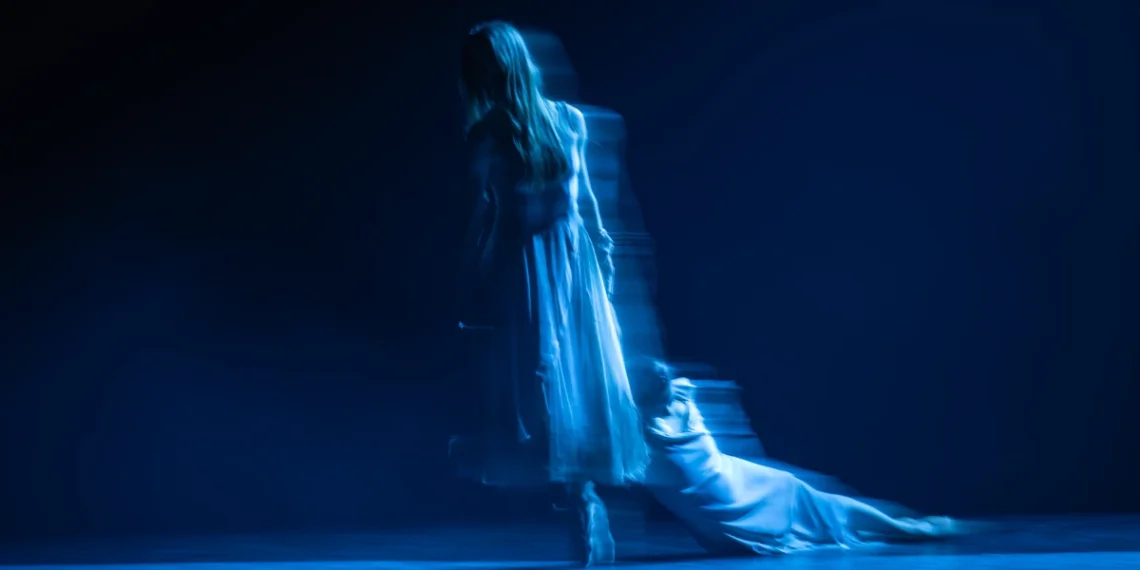
Featured Photo of English National Ballet‘s Emily Suzuki as Giselle and Emma Hawes as Myrtha in Akram Khan’s Giselle © Photography by ASH.