
The dancers of the Spanish National Dance Company (Compañía Nacional de Danza), along with those of the Spanish National Ballet (Ballet Nacional de España), are taking a last-resort step in an effort to be heard.
The artists of both of Spain’s national dance companies are calling a strike for December 19, 2025 during the performance run of the Compañía Nacional de Danza (CND) “NumEros” program at Madrid’s Teatro de la Zarzuela.
This action marks a breaking point after three decades of frozen wages and deteriorating working conditions in two of the country’s most prestigious public dance institutions, both operating under the government’s National Institute of Performing Arts and Music (INAEM).
With the support of major unions UGT, CCOO, and CSIF, they are demanding that their working conditions finally reflect the excellence and dedication they bring to Spanish culture.
UPDATES
December 17, 2025
Productive conversations between the dancers and INAEM have begun with a meeting scheduled for February to confirm changes that will take place in the first months of 2026. The strike has been called off.
Support the dancers of the Spanish National Dance Company and the Spanish National Ballet
In a call for public support, both of Spain’s national dance companies have launched a joint petition for change.
I reached out to CND’s dancers to learn more about their current situation and feelings, and via their main representative (who is also a dancer with the company), I received responses from a sampling of them. Upon assurance that what they voiced is indeed the consensus, with permission, I have condensed and edited their answers for clarity.
You may also like...

An Interview with Olga Smirnova and Jacopo Tissi: Dancing to Connect, Not to Impress
Olga Smirnova & Jacopo Tissi discuss the van Manen factor, artistic journeys, and what it means to be a part of Dutch National Ballet's return to New York City.
An Interview with AGMA Artists at New York City Ballet: Trading in Glitter for Grit
The AGMA Artists at New York City Ballet bring further light to what led to their boycott of the Fall Fashion Gala and what they're actually fighting for.
Interview with Dancers of the Spanish National Dance Company
‣ Salaries haven’t been updated for thirty years… that’s 1.5 generations! What does this mean in practical terms for daily life in Madrid?
The cost of living has gone up significantly the last couple of years and our salaries have not kept up. The fact that salaries haven’t been adjusted for thirty years has a direct and very concrete impact on our daily lives. We earn less than the average salary in the Community of Madrid.
This means that, with salaries that haven’t adjusted in three decades, it’s very difficult to cover basic expenses in Madrid today. Housing, utilities, food, and even healthcare have risen enormously, while our salaries remain stuck in another era.
Many dancers share apartments throughout their professional career as it’s impossible to rent a place to live on their own near their workplace. Most of us are forced to live on the outskirts of Madrid or to spend well over a third of our salary – a disproportionate portion – on rent or a mortgage, which is simply not sustainable.
Many of us depend on a second job to supplement our income.
This is especially difficult given the physical and time demands of the profession and something that shouldn't happen in a national dance company with such high standards in a highly specialized career.
Alongside the astronomical rent prices in the city, everything added up makes it extremely difficult to live in Madrid. This means a continuous loss of purchasing power and hinders personal stability, long-term planning, and, in some cases, even continued professional development.
‣ How do current salaries compare to what is needed to live with dignity in Spain’s capital city?
There is a clear gap between what a dancer earns and what is needed to live in Madrid as the cost of living here in recent years has risen very rapidly and significantly, especially for housing, transportation, and food.
Our current salaries don’t reflect this reality and don’t allow us to live with stability and dignity. We’re not talking about luxuries; we’re talking about being able to pay rent, eat well, and have a minimum amount of financial security.
It is very difficult to maintain a decent life here without constant sacrifices, something incompatible with a profession that demands great responsibility, rest, and physical care.
‣ Aside from monetary considerations, another motive for this call to action are some of the working conditions which can push dancers to their physical and mental limits.
For example, during tours, the dancers have 9-hour scheduled days plus need to be available for all 24 hours. What does a typical touring week look like for a CND dancer, and what are the costs of performing under these conditions?
During a tour, days are usually long, demanding, and intense: warm-ups, rehearsals, performances, physical recovery, travel, and waiting times that, although not always officially recorded, are all part of the job.
Being available practically 24/7 generates significant physical strain, increases the risk of injury, and hinders recovery. Despite an excellent and highly dedicated physiotherapy team (who work the same hours as our rehearsals and performances), resources are insufficient for the number of dancers in the company. This means that many cannot access the treatment they need at the right time or as often as necessary.
As a result, much of the physical and mental well-being of the dancer falls on themselves. Essential treatments such as additional physiotherapy, massages, osteopathy, physical conditioning (Pilates, yoga, gym workouts, Gyrotonic), nutrition, and psychological support must be paid for entirely out of dancers’ pockets.
In a profession with high physical risk and short careers, this represents a constant and unavoidable expense that is not covered by current employment conditions.
Added to all of this is the mental exhaustion of being away from home for weeks at a time and the constant adaptation to new performance spaces.
In the long run, this pace has a clear impact on our health and careers; our bodies are our tools of the trade, and these conditions often push them to their limits.
‣ What exactly does agravio comparativo (comparative grievance), as expressed in your press release, mean with respect to other INAEM organizations, and why is this important to the dancers of CND?
Within INAEM, there are clear differences between institutions that perform work of similar artistic and physical demands. Compared to us – the two national dance companies – the others receive more favorable salary, working conditions, allowances, and professional recognition.
This distinction is important to us because we are talking about wanting equal treatment within the same public structure. We are not asking for more than anyone else; we are asking to be treated the same. At the moment, it seems that INAEM is able to provide dignified conditions to some but not all of their organizations despite them sharing the same level of demands, dedication, and public service.
Correcting this injustice is a matter of fairness.
‣ From what I understand, a strike and protest will take place on December 19, 2025 if no reasonable actions are taken by the Ministry of Culture (the umbrella government agency for INAEM) to address the dancers’ concerns by then.
How was this date decided upon despite the potential impact on CND’s current run of performances? It must have been a difficult decision to make.
It was a very difficult decision made after a lengthy internal dialogue and a great sense of responsibility with the intention of allowing sufficient time for the administration to respond.
We are aware of the impact on programming and it was not a decision taken lightly, but it reflects the urgency of the precarious situation the national dance companies are in after decades without structural changes.
After 30 years without real solutions, we felt there were no other options.The date was chosen as a last resort to highlight an unsustainable situation and force a serious dialogue with the Ministry of Culture.
‣ This initiative came directly from the dancers themselves. How did you organize among yourselves – and across two companies – to reach this point? What was the process like of deciding collectively to take such a significant step after 30 years of these conditions?
Organizing between the Spanish National Dance Company and the Spanish National Ballet has required dialogue, trust, and a lot of courage.
This initiative originated from within after months of deep reflection; it has been a long process. We’ve talked a lot, shared experiences, and developed a collective awareness that what we’re going through isn’t normal or fair. We share very similar challenges, and that facilitated collaboration between companies.
The common feeling was that the situation was no longer sustainable. With the support of the unions, we were able to structure a demand that originates from within the group itself, in a responsible and united manner.
Deciding to take this step after 30 years under these conditions wasn't impulsive; it was very carefully considered.
‣ Beyond the immediate demand for updated salaries, benefits, and working regulations, what does a sustainable and dignified model look like for professional dancers in Spain’s national companies?
A sustainable model requires updated salaries, stable bonuses, overtime pay, and adequate allowances.
It also means clear regulation of working hours and measures to protect our health.
It means recognizing the specific nature of our profession, its physical demands, and the fact that we have a short career lifespan.
It means transition measures at the end of a performing career.
Investing in dancers is investing in artistic quality and public culture.
‣ What norms would need to be put in place to ensure that future generations of dancers don’t face the same precarity?
We cannot allow new generations of dancers to inherit the precariousness we are currently experiencing as normal.
If we want strong, high-quality national dance companies, care must be taken of those who sustain them. At the moment, it is becoming increasingly common for Spanish dancers to emigrate to other countries in search of decent wages.
It is essential to update labor frameworks, regularly review economic conditions, establish clear workload limits, and guarantee social protection mechanisms. Otherwise, we will continue to produce highly skilled professionals who will be unable to support themselves within the public system.
Ensuring decent working conditions is key to the future of Spain’s national dance companies.
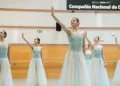
Featured Image of dancers of the Spanish National Dance Company (Compañía Nacional de Danza) rehearsing George Balanchine’s Serenade. Photo by Alba Muriel, courtesy of the dancers of CND.