The NY Philharmonic and L.A. Dance Project Review
October 11, 2025 | David Geffen Hall – New York, NY, USA
After attending my first orchestral performance a few years ago, I recall being struck by the rituals of classical music, specifically the unwritten rule: no clapping between movements.
This differs greatly from the ballet world, where applause is expected. I am not here to argue for or against that tradition, but rather to observe how this etiquette invites a deeper kind of listening, encouraging the audience to lock in.
You may also like...
Joburg Ballet Communion of Light Review: Connection Even in Darkness
Despite the company's spirit of hope and creativity, Joburg Ballet touched on some rather dark and heavy themes in Communion of Light.
Turn It Out With Tiler Peck & Friends Review: A Prima, Making It All Happen
As curator of Turn It Out With Tiler Peck & Friends - and together with her stellar retinue - Peck puts on a show that not only inspires but also proclaims how she is setting a new standard in the...
The NY Philharmonic and L.A. Dance Project Review
To start, not a single cell phone rang during the Pierre Boulez at 100 performance at The NY Philharmonic, a plague amongst ballet audiences which no pre-show announcement seems to deter.
I realize one show hardly makes for an ample data set. Still, I suspect that respect for sound enforces a deeper reverence for the rules. That isn’t to say the hall was “library quiet” either. The gentle rustling of papers and the occasional cough or sneeze became an orchestration of their own.
Nor is that to say the Philharmonic attendees take themselves too seriously. At the close of the first movement (“Introduzione”) from Béla Bartók’s Concerto for Orchestra, a punctuated final chord drove an audience member to yell “woo!” which resulted in warm audience laughter.
Esa-Pekka Salonen conducted, opening with Igor Stravinsky’s Octet for Wind Instruments, a subtly humorous fanfare that the eight musicians played with exactitude and delight.
Salonen conducts with energy and at times flair, but here he remained stoic. Perhaps evoking Stravinsky’s recurring nationalistic undertones, Salonen hit rigid postures, revisiting the shape of a capital T with his arms and baton.
In the second number, Salonen surrendered to Bartók’s music beginning with the low hum of the violins as he conducted low and small. This calm is short-lived in the spasmodic concerto, where moods switch every 32 counts.
As a listener, it’s impossible to predict the music’s next direction but Salonen’s wild gestures match each burst.
He is the captain steering through Bartók’s waves.
It’s in works like this that the NY Philharmonic really shines – there’s power, precision, and fervor.
The evening’s focus was Pierre Boulez, Music Director of the Philharmonic from 1971-1977, whose Rituel in memoriam Bruno Maderna for Orchestra in Eight Groups honored his late friend and fellow composer. Here, the experience completely shifted for me. The music moved beyond just an invitation to listen.
I was invited to reconsider space, observe relationships, and contemplate music as conversation - and all of it heightened by the accompanying performance by L.A. Dance Project.
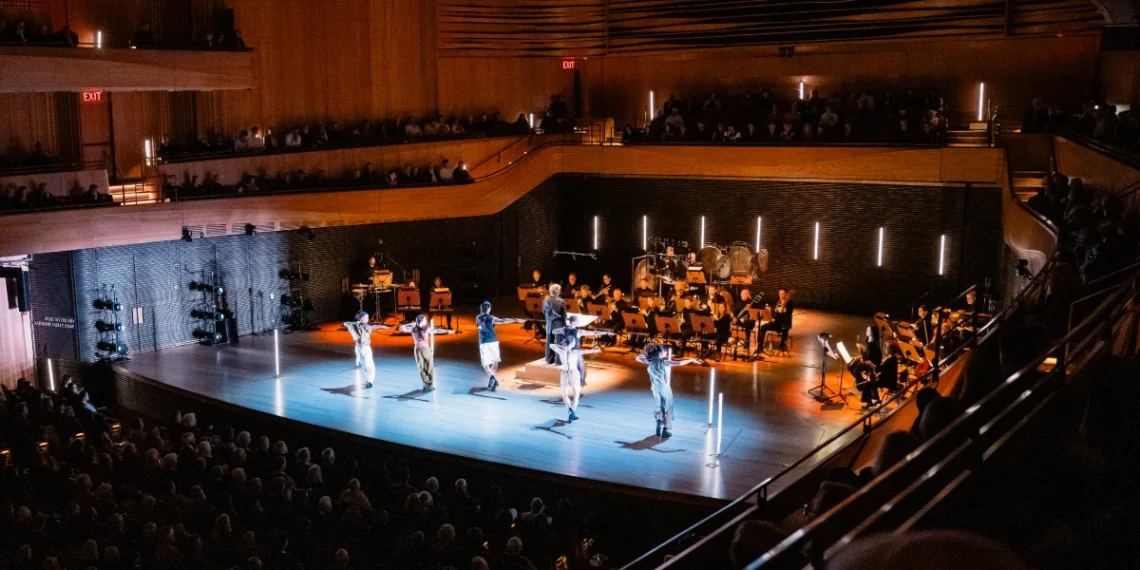
The collaboration makes sense as Boulez included some choreography of his own with a distinct seating chart for the musicians: strings, percussion and woodwinds were split into three groups on the stage with additional musicians playfully tucked in the upper corners of the balcony.
Choreographer Benjamin Millepied takes full advantage of the unconventional setup, winding his dancers through the percussion and even lying across the foot of Salonen’s podium.
He is also clever in how and when he explores repetition. Revisited shapes are expanded and developed: a duet later becomes a sextet but retains the core elements of its first iteration. The dancers, each exceptional, moved through big, surrendering backbends and slow-motion punches.
Millepied seems to hint at something primal, echoing The Rite of Spring, yet clear imagery formed only to dissolve again.
In the same way the choreography feels like it’s searching for solid ground, although creating a pleasing perplexity, Boulez’s music is mercurial and evasive. The instruments exchange attitudes the way we once channel-surfed, paralleling the dancer’s searching.
Sometimes not arriving can be just as intriguing as landing somewhere.
Featured Photo of the NY Philharmonic, conducted by Esa-Pekka Salonen, and L.A. Dance Project with choreography by Benjamin Millepied. Photo by Brandon Patoc.