Pacific Northwest Ballet In The Upper Room Review
November 20, 2025 | Digital
Pacific Northwest Ballet’s triple-bill In the Upper Room offers an evening of variety, pairing a world premiere with an intimate contemporary work and closing with a masterpiece so iconic that it earned the program’s title.
AfterTime, The Window, and In the Upper Room showcase the company’s range and the individual artistry of its dancers, from newly minted principals to standout members of the corps de ballet.
You may also like...
Sons of Echo Review: Co-Birthing a New Masculinity
Sons of Echo Review: Daniil Simkin's show unfolds as a thoughtfully curated evening featuring 4 female creators' explorations of what positive masculinity is.
English National Ballet Giselle Review: A Dark Take on a Romantic Classic
English National Ballet Giselle Review: In Akram Khan's vision, despite the tension between desolation and freedom, perhaps the end is not always the end.
Pacific Northwest Ballet In The Upper Room Review
The evening opens with AfterTime, a world premiere choreographed by Pacific Northwest Ballet dancers Christopher D’Ariano and Amanda Morgan.
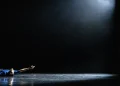
Eschewing a traditional ballet opening, The Protagonists crawl out of the orchestra pit and establish their presence and primal existence in front of the proscenium. Eventually, having made their way behind the ultimately-rising curtain and onto the main stage, Leah Terada and Joh Morrill’s dancing – embodying something more creature than human – activates a series of flashing images.
Whether this representation of how the evolution of technology and science has interrupted civilization is welcome or invasive is left to the eyes and mind of the beholder.
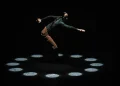
An alien morse-code pattern of lights plays across the horizon on the backstage scrim, signaling the incoming cyborg-like beings. The System is a collective dressed in what initially appears as silver and gunmetal in the dim lights yet later, in close-up, are revealed to be red and blue. Their movement quality is angular and rigid, a stark contrast to The Protagonists who, barefoot and dressed in rags, embody a more organic vocabulary.
The visual and audio design prove as compelling as the choreography, their interplay with the dancing creating fascinating tensions: sometimes the music mirrors the mechanical System, while at other moments, trance-like electronica sharply defies the spasmodic physicality.
According to the program notes, AfterTime “showcases the importance of these connections, and crossing boundaries when it comes to interdisciplinary intersections in dance”; this ambition is realized through the work’s fusion of theatrical design, a discordant soundscape, and contrasting corporal languages.
Dani Rowe’s The Window provides the evening’s emotional heart, a meditation on voyeurism.
The piece begins with particular poignancy as D’Ariano takes the stage just minutes after his promotion to Principal is announced to the audience.
Inspired by “The Living Room,” a true story recounted by Diane Weipert about a woman who watches her neighbors through a window, the ballet, narrated in chapters, abstracts and physicalizes what the program notes describe as
“the uncanny experience of witnessing life’s most urgent moments as they happen to other people in our lives.”
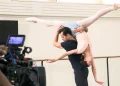
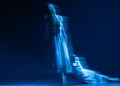
In the second chapter we see D’Ariano and Elizabeth Murphy appear as The Man and The Woman, housed within a square of light suggesting a domestic interior, dancing with an easy joy. Outside this figurative frame, Melisa Guilliams inhabits The Watcher with remarkable nuance, her face expressing a spectrum from angst and despair to glimpses of happiness.
Most compellingly, Guilliams conveys how The Watcher becomes caught up in her own feelings provoked by what she observes, daydreaming as if the life she witnesses were her very own.
As the story progresses, The Man returns home one day unwell, and The Woman’s joy transforms into grief. She clings on to visceral memories – and literally, The Man’s shirt – while The Watcher remains outside, empathetic yet separate. The two women dance side by side, The Watcher aware of The Woman, but the latter unknowing that her life is being observed.
Their planes – beautifully and illogically – cross in a striking moment when The Watcher takes the shirt from The Woman and dresses her in it, a gesture both tender and transgressive.
The piece concludes with The Woman looking out the window but not seeing – perhaps just sensing – as The Watcher looks back in one final time before The Woman walks away.
Twyla Tharp’s In the Upper Room closes the program with pure kinetics set to a propulsive, unmistakably Philip Glass, score.
The piece establishes its split personality immediately: two women in sneakers, black and white shirts and pants, joined by three men dressed identically, are later joined by couples of which the women are wearing short skirts and striking red pointe shoes. Were it not for the coordinating pinstripes, one might think two separate pieces were unfolding simultaneously.
The musical architecture provides the key to understanding this duality. The sneaker-clad ensemble made up of Destiny Wimpye, Melisa Guilliams, Genevieve Waldorf, Morrill (dancing for Luther DeMyer), Noah Martzall, and D’Ariano follow the rhythmic constant drive that is signature Glass.
Meanwhile, the pointe shoed dancers respond to the more melodic strings, with Clara Ruf Maldonado and Yuki Takahashi displaying exceptionally quick footwork in their duets.
The sneaker sextet proves particularly captivating. Their deadpan expressions create a comedic contrast with the playful music, and when they return later with shirts removed to reveal red racerback tanks, their expressions seem to say "we're cute and we know it."
As the piece progresses, visual cohesion emerges from the initial chaos as the women in pointe shoes all transition into short red dresses while those in sneakers appear in red short unitards. With both groups now donning scarlet, my eye could much better appreciate the moments when the dancers fell into sync amid the controlled chaos.
Despite being an ensemble work, In the Upper Room grants opportunity for individuals to shine through.
Wimpye is joy and charm personified, while Waldorf, who also caught my attention in last season’s The Sleeping Beauty, once again proves a standout.
Imagine my delightful surprise when the piece concluded with these two young corps dancers holding the stage – the cherry on top of a decadent night that celebrated promotions while demonstrating that artistry transcends rank.
It was wonderful to see veteran principal dancers alongside these rising stars, especially in the finale when the athleticism, technique, energy, strength, and camaraderie are on full display. If it weren’t for the drops of sweat and the occasional musical asynchronicity, one wouldn’t know that this thirteen-member cast had just danced for forty minutes.
In the Upper Room provided the perfect conclusion to an evening that moved from dystopian drama through intimate observation to communal celebration, showcasing Pacific Northwest Ballet’s depth, versatility, and the electric vitality that makes live dance – even in streaming – an irreplaceable experience.
Featured Photo for this Pacific Northwest Ballet In The Upper Room review of principal dancers Christopher D’Ariano and Elizabeth Murphy in Dani Rowe’s The Window. Photo © Angela Sterling.