Jacques D’Amboise is performing. He is Apollo all over again, decades after he last danced this iconic role that had been one of his signatures during his years as a principal dancer with New York City Ballet.
But now, it’s 2012, and Jacques is in a bland dance studio, coaching then-NYCB principal dancer Robert Fairchild.
He takes the lyre from Robert, cues the pianist accompanying this rehearsal (“Going on!”) and, hearing the first notes of music, it seems as if a dormant pilot light ignites inside him.
He begins to move, demonstrating exactly how to cradle the instrument, gesturing with it to show the young god’s indecision, trepidation, confusion – yes, with words of explanation, but mostly with his body.
With his face.
You can see every word of Jacques’ – and Apollo’s – inner dialogue, every emotion, as delicate but insistent as a bow carefully playing a violin string, in his arms, shoulders, in the sensitive and deliberate placement of his sneaker-clad foot.
In Balanchine's Steps
This what I saw in a clip from the George Balanchine Foundation’s Video Archives, an initiative marking its 30th year of recording coaching sessions between former dancers on whom George Balanchine created roles and the dancers of today who are tasked with carrying on the legacy of those works while also keeping them distinctly vibrant, vivid, and alive.
Exactly as Balanchine himself would have wanted.
In honor of this anniversary (and perhaps as a way to remind the public of their existence and the importance of their continuity), the Foundation has created a new book, In Balanchine’s Steps: How the George Balanchine Foundation Preserves His Genius, featuring a collection of still photographs taken during the coaching sessions, accompanied by comments from participants in the project: dancers, observers, and critics.
Thirty-two coaches are featured in this book, which includes over 200 photographs.
It does not represent the entirety of the Archives. In Balanchine’s Steps’ designer and photo editor Kyle Froman says that many of the earlier sessions that the Foundation orchestrated were not photographed, and of the ones that were, Froman prioritized curating groups of images from the sessions that could best express the intention of the book.
The goal, to Froman, was more than simple documentation.
He knew there was significance in these photographs, and that they, in their own way, tell a different story – or, at least, tell it from a different angle – than what a person might glean from watching the videos.
The early sessions (1995-2004) were photographed by Brian Rushton, whose style reflected a taste for capturing a mood in the studio; the shots are black and white, less crystalline, more hazy.
When the photographer Costas took over in 2005, the photos became brighter and sharper, as if there’s an urgency to cast light and color on the physical details as much as the impetus behind them.
Not that the emotions of the coaches aren’t at the forefront of these images – their faces and bodies translate so much, so clearly. But it’s apparent that the purpose was, and is, to crystallize, define, and permanently record the nuances contained in the muscle memory of the roles’ originators.
Why make a book about a series of videos? What could possibly be gained from collecting and analyzing still images about dance, an art form that is defined by not being still?
Maybe that’s it. While the flow of a dance carries the audience right along with it, there is great value in the camera’s ability to catch and freeze moments in time.
Studying these coaches’ and dancers’ faces and bodies in a series of specific split-second frames is, to me, as fascinating and revealing as being in the room where it happened. And it makes you feel as if you are there, right now. Time is suspended.
Froman agrees.
A former New York City Ballet dancer himself who retired in 2009 to pursue photography, Froman was in a unique position to honor the work of the Foundation, the coaches, and the dancers.
When Froman was approached by the Foundation to curate the photographs and design the overall concept for this book, he’d already seen firsthand, and had deep appreciation for, the technology-resistant person-to-person translation of ballets.
He recalls being coached by Suzanne Farrell and Paul Mejia during his own performing days (at Fort Worth Ballet, where he danced before joining NYCB.) Their direct lineage to Balanchine made the ballets he learned from them come alive.“Ballet only survives from that process. Suzanne and Paul’s word choices in describing steps colored the way we did them and unlocked a lot of insight about them.
The Foundation basically left it up to me to shape this book, saying, ‘Make a book you, as a dancer, would want to see.’
So to do something like this for Balanchine made my soul feel good. I could give back even though I’m out of that world.”
In the days before high-quality video of dance was widely available and easily accessible, all that ambitious, curious young dancers like myself had were books and photos (and live performances, of course).
I, like my peers, spent hours poring over images in books, souvenir programs, and magazines, analyzing every minute detail. Seeing live performance captured my spirit; staring at photographs honed my eye for line, expression, individuality, and technique.
Through photography, dancers like me (and fans, too) learned the power of subtlety by being able to see a performer’s gaze directed just so and the way the placement of a foot or a hand conveys a certain kind of energy or sentiment.
Still photography helps define a dancer’s movement quality. A photograph can pull you in and hold you there in a way that watching an on-stage performance, or even a video recording, can’t.
The coaching sessions depicted in In Balanchine’s Steps do exactly that: they break down the large concepts that the originators are passing on into segments, like samples on a slide, so that we can look at them under the microscope of our senses.
Suzanne Farrell throws her head back, showing her legendary long neck and unmistakable profile, and in that pose, we understand the sweep of movement that Balanchine wanted in Meditation.
The slight lift of Patricia McBride’s shoulder and the coy expression on her face as she demonstrates Harlequinade tells us – and, more importantly, the dancers who will take on that role – about the characterization she made famous.
The text accompanying each group of photos is illuminating, too, as former and current dancers, critics, and longtime observers describe their own roles and thoughts on the processes of remembering, teaching, learning, and documenting the precious legacy of George Balanchine.
Froman says this book is a way of telling several stories within a larger one about the ongoing links between people holding knowledge and artistry.
“I thought of these photos as like stills from a film.
As a dancer, you see the movement through a gesture. And that can add a mystery to the whole thing, which is exciting to look at. You don’t always have to understand everything, but it’s those that stand out that are intriguing in some way.”
The theme of time hovers over the pages and is woven into the commentaries.
“Even the barre running across the back of the studio in all the photographs represents something,” Froman noted. “It’s consistent. This continual flow, going forward.”
Like these ballets – hand to hand, always moving ahead, but what came before remains.
It’s common and semi-controversial knowledge in the ballet world that the ballets themselves, particularly Balanchine’s, have and will continue to evolve.
Ballet, not even the earliest pieces of choreography, will never be a museum artifact; the fact of performance by a living dancer makes any piece current, no matter how “old” the steps they are dancing.
But preservation of intent matters. A lot.
Balanchine was also known for his own discomfort with the idea of permanence and his exhortations to exist in the now, but the genius of his choreographic inventions has to be exempted from erosion.
“Things morph, whether you try to freeze them or not,” says Froman. “They change over time, and they should, depending on who is dancing and where we are in this world. But some things should never change.”
In honor of the 30th anniversary of the George Balanchine Foundation's Video Archives, former New York City Ballet dancer Kyle Froman has curated photographs by Costas and Brian Rushton which capture dancers working with legendary coaches. Short essays accompany the images, shedding further insight to these special moments in time eternalized on film. Gavin Larsen dives deeper into the significance of this book.
One of the most beautiful and touching aspects of the Video Archives is, to me, the gift to the originators of the opportunity to perform again, like Jacques re-living his role as Apollo.
Froman told me that he’s always been fascinated by dancers’ transitions: what happens to them after they bow for the last time, what they make of the rest of their lives, and how ballet continues to influence that future life.
He and I joked a bit about what we don’t miss about being a dancer – warming up, pointing our feet – but agreed that almost universally, what retired dancers do miss is performing.
While many go on to teach, coach and stage ballets for students and professionals, being asked to truly dig down into the archives of their own memories and bodies, to share what they know, to illuminate and reflect and explain for an audience hanging on their every word and movement…
To dance again and feel their connection to Balanchine come back to life… that’s the greatest gift to us all.
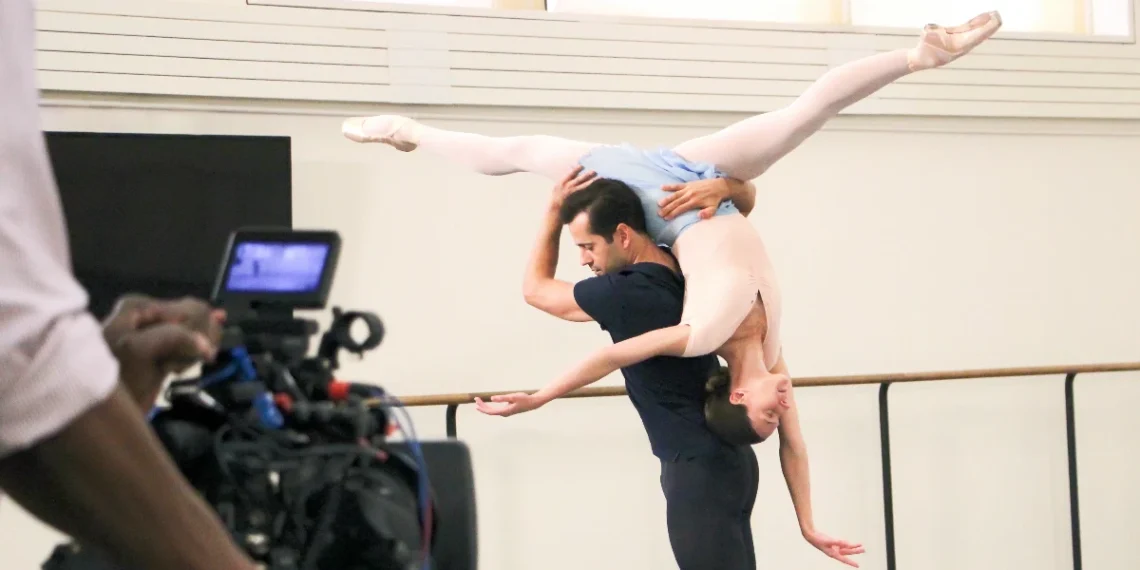
Featured Photo of former New York City Ballet dancer Robert Fairchild and American Ballet Theatre’s Devon Teuscher dancing the pas de deux from George Balanchine’s Apollo in 2023. Photo by Costas.