

Sons of Echo Review
January 14, 2026 | The Joyce Theater – New York, NY, USA
“I wanted to explore what it means to be a good man. What is positive masculinity in our day and time right now?
– Daniil Simkin, principal dancer and creator of Sons of Echo, in conversation with Pointe Magazine
We have been hearing a great deal lately about the effects of “toxic masculinity,” but what exactly is “positive masculinity”? And what does it look like in practice?
Under the direction of Daniil Simkin, a team of exceptional artists – four women in particular – set out to explore these questions in Sons of Echo. This one-of-a-kind performance unfolds as a thoughtfully curated evening, made up of:
- a playful ballet class that establishes joyful camaraderie among male principals;
- a Lucinda Childs work reflecting on calm connections;
- a trio by Tiler Peck on shedding the ego;
- a duet by Anne Plamondon centered on interdependent relationships;
- and a brand-new dance by Drew Jacoby that embraces emotional transparency.
You may also like...
English National Ballet Giselle Review: A Dark Take on a Romantic Classic
English National Ballet Giselle Review: In Akram Khan's vision, despite the tension between desolation and freedom, perhaps the end is not always the end.
Joshua Beamish/MOVETHECOMPANY Review: In Solos & Duets, a Solo Rises to the Top
Joshua Beamish/MOVETHECOMPANY Review: The choreography for Lost Touch feels clean, intentional, complete - a cue for the possibilities ahead in Vancouver.
Sons of Echo Review
It was an introduction unlike anything I had ever seen before. As the audience filled the house, Simkin, joined by his star-studded peers Jeffrey Cirio, Osiel Gouneo, Alban Lendorf, and Siphesihle November, invited viewers to witness their warm-up at the barre.
With nothing to hide, the men challenged one another and revealed astonishing technical authenticities as they prepared for Class, the title of the evening’s opening work.
Armed with humor and vocalizations, Tomas Karlborg, the fatherly ballet master behind the viral “Pas de Balanchine” combination, led the class. He sang out the exact musical phrases for the live accompanist to playback (Vladimir Rumyantsev) as the small-but-mighty Maria Kochetkova casually popped in for a cameo in a pair of red gym shorts.
It quickly became clear that Class could have stood on its own as a complete performance.
After showcasing an abundance of bravura, Karlborg even invited the audience to film on their phones – another unprecedented feature that I (and my Insta) loved.
Having earned the audience’s trust through a clever preshow starter, the evening then shifted toward a deeper inquiry: What does positive masculinity look like today?
That question first came into focus in Lucinda Childs’ Notes where clarity, calm and collective awareness replaced virtuosity.
Cirio, Lendorf, and November, clad only in white bell-bottomed pants, dancing to the score of a soft piano (Matteo Myderwyk), smoothly traveling in space, performing temp levés with hands flexed over their heads, going through each other, at times arms linked, pulling and reaching towards the wings.
One message of the piece is to remain harmoniously calm in the choreography and with each other. Another: finding a way to stay connected despite the inevitable disconnections.
Gouneo calmly waltzes on, making everything look so much more restrained compared to his unstoppable turns during Class.
Cirio partners the smiling November mid-stage before they serenely walk off on a diagonal.
And Lendorf, parking himself in a tendu, then scoops his arm downwards and sideways, dancing until his body glistened.
These simple yet meditative sections perhaps aimed to show a more purified version of mankind.
And programming Notes directly after Class was a strategic choice, shifting the evening from technical fireworks into minimalism without losing momentum.
After intermission, Tiler Peck’s world premiere Real Truth continued the inquiry.
Her piece opens with Simkin, Lendorf, and Gouneo slowly forming sculptural silhouettes, their movements suggesting a collective search for something. Gregory Porter’s baritone voice sings,
“…you can leave your ego at the door… everybody now can live a lie… open your mind and you will see…”
prompting the audience to sympathize with the dancers’ intentional probings.
Simkin’s signature pirouettes – particularly to the left – were thrilling, though at times repetitive.
Later, the men lace their arms, arcing over and around one another as they claim space, leaping, stepping diagonally into wide fourth positions, and cabriole-ing seamlessly into crisp chaîné turns.
Peck’s choreography continues to explore how to let go of oneself and seek out what really matters in sustained attitude turns and expansive traveling phrases, fusing ballet, contemporary, and jazz vocabularies in satisfying ways.
Poems by Monty Richthofen, spoken in blackout, seamlessly bridged the female choreographies and led into Anne Plamondon’s duet Will You Catch My Fall.
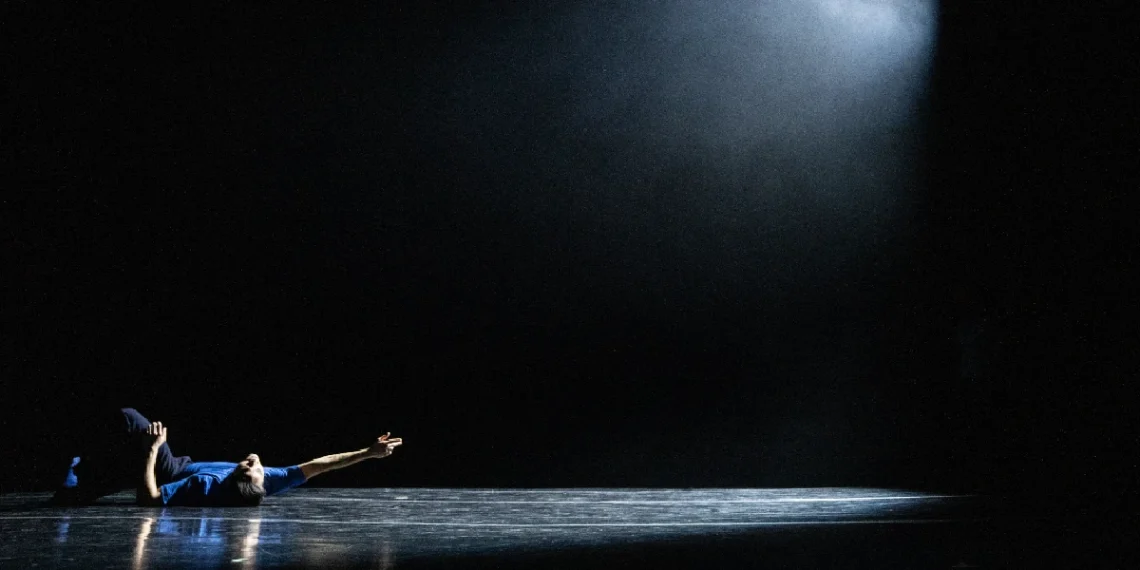
Bathed in deep blue light, Cirio and November moved at a low level, snaking side by side, their weight constantly negotiated. Floorwork suggested tangling and untangling, dependence and release.
Ouri’s whispered female voice offered directives – “Catch with your whole body,” “Feel my weight”- underscoring how vulnerability isn’t a weakness but an essential component of forming trust in a relationship.
A particular standout moment was when November rescues Cirio, like an angel comforting someone who has fallen. It was also Cirio’s best performance of the evening.
The program closed with Jack, choreographed by the contemporary ballet mainstay Drew Jacoby.
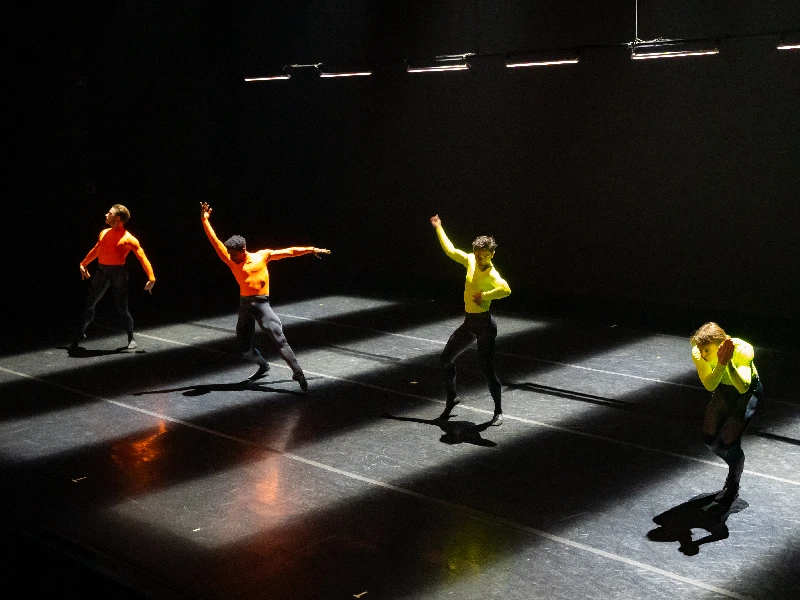
Cirio, Simkin, Lendorf, and Gouneo appeared midstage in neon-colored tops, evoking competitive cyclists of Tour de France (minus the helmets). Set to futuristic soundscapes, the choreography oscillated between refinement and absurdity: polished ballet lines suddenly fractured by goofy gestures, and some glitchy solos and self-centered exaggerations.
The men muscled through their spandex under Manuel Da Silva’s lighting design. Moments also seemed Merce Cunningham-like, showing off angular balletic shapes in their black leggings.
Cirio dances to the side then starts mocking Leonard Bernstein’s conducting, turning his legs in and out, ultimately tiptoeing off stage after some weird slapping of his thighs.
Simkin’s solo captured the tension between technical excellence and emotional breakdowns, while Gouneo’s crowned pirouettes suggested narcissism and inner dissonance.
The takeaway: Jack allowed the dancers to express conflicting emotions openly, rather than suppress them.
The men return to flock and skate through space, echoing jump rope gestures and motifs from their solos, releasing a final collective breath as the stage falls to blackout.
I am in full support of more famous dancers collaborating with each other to curate their own dance events.
And I am particularly curious to see the development of a show where an all-male choreographic team can offer a compelling iteration of Sons of Echo. Maybe someone can start the conversation on “positive femininity” as well so we can improve as a species.
A thing to reconsider: The raw and fleshy pre-show marketing photos felt disconnected from the actual performance.
But all in all, Simkin’s approach - promoting positive masculinity through works choreographed by women - felt radically innovative.
The live ballet class that preceded the program also offered a generous, unguarded portrait of what men can do and who they can be as providers and protectors.
I applaud Simkin for drawing on social science and Greek mythology to create works that improve our world. He started a fascinating exploration that hopefully will germinate into a greater body of work and I’m honored to have experienced its first conception.
Featured Photo of Jeffrey Cirio in Will You Catch My Fall by Anne Plamondon in the program Sons of Echo performed at The Joyce Theater. Photo by Steven Pisano.