Birmingham Royal Ballet Don Quixote Review
April 23, 2026 | Sadler’s Wells Theatre – London, England
It is a Thursday evening in April, and the foyer to Sadler’s Wells is buzzing. The atmosphere of excitement is in anticipation of the performance of Carlos Acosta’s Don Quixote by Birmingham Royal Ballet.
This bright and iconic ballet always draws an eager audience, and only the more so when connected with Acosta who is so known for his multifaceted connections with this work. So much of the ballet community will associate this ballet, and particularly the role of Basilio, with Acosta himself.
We are thrilled to see how his own company will succeed in capturing the electric energy and present abandon Acosta always brought to the stage in this production.
You may also like...
In Dance, Francis Patrelle Review: Moving Forward, Without The Captain
Francis Patrelle, who devoted his life to telling stories through ballet, is honored in an in memoriam program assembled with affection.
Pacific Northwest Ballet Firebird Review: Contemporary Wins and a Classic Revisited
Pacific Northwest Ballet Firebird Review: PNB's spring program is a multi-faceted triple bill featuring three pieces of entirely different looks and sounds.
Birmingham Royal Ballet Don Quixote Review
The overture swells and the lights lift, but I have to say it does take the length of the prologue to adjust into the world of 17th century Spain. At first, the contrast between the slick modernity of the functional Sadler’s Wells and the homey, warm and slightly gritty world of Don Quixote is too strong to fall into the story.
Once the rest of the stage is revealed onto the town square of Act 1 however, the genius of the care taken with this set becomes evident. Our surroundings as audience members become entirely secondary.
I am immediately impressed by the engagement and energy of the corps de ballet as they slowly fill the mise en scene of the stage.
The bustling town square coming to life as the variety of characters and personalities paints a textured and delightful scene. Maturity and confidence as an artist are required to achieve this level of stage presence. We feel the importance of each character.
Even so, Momoko Hirata’s bright and open childlike energy instantly captures our attention in her first entrance as Kitri. She is all playful, confident, mature and sweet. A perfect pocket rocket of technique and energy for this role.
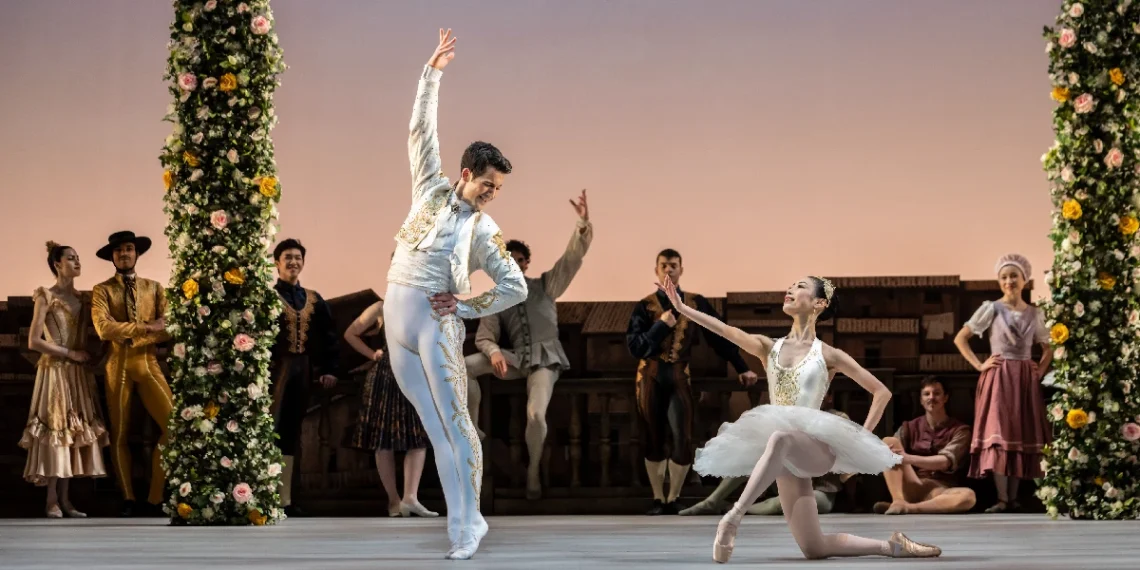
In contrast, Mathias Dingman brings a calmer, yet still commanding presence as Basilio. The chemistry between the two is strong from the get go. Dingman’s soft and assured power pairs beautifully with Hirata’s fiery speed and wit. This is a very exciting beginning to the ballet; I have high expectations.
Adding to all of this is the consistent confidence, musicality and dynamic from the company as a whole. They have evidently been very well rehearsed and the ownership of their roles really shines through. Principals, soloists and corps all interact seamlessly creating a very
real scene. Characters such as Espada, Mercedes and Kitri’s girlfriends are active participants in the mise en scene of the space while also transitioning into their featured moments with humility and realism.
This ballet relies heavily on the unification and energy of the corps, and Birmingham Royal Ballet is delivering this with expertise. We can feel their joy and comradery.
The costuming should also be noted in adding to this visually - there is an expert balance finding cohesion in variation, adding to the bustling Spanish flavour of the ballet.
The second act opens with a touching pas de deux between Kitri and Basilio as they reach the gypsy encampment. This moment often does not stand out to me in the narrative of the ballet, but tonight I found Hirata and Dingman’s dynamic very touching – his care coupled with her naive joy and confidence really comes through in how they dance here.
The gypsy scene offers a tasteful change in quality and visuals with very minimal use of set. The movement quality is round and grounded, accentuated by garishly decorated flowy costumes and dark lighting.
Unfortunately, from a rehearsal perspective this section feels the weakest from the corps. However, the energy and commitment from the dancers still pulls through.
One particularly striking and beautiful moment to note is during the bonfire scene when a guitarist joins the stage space with the dancers playing live. This scene is wonderfully atmospheric and creates a surprising intimacy for the vast space of the stage.
We now transition into the Garden of the Dryads. This change is signified by the draping of the stage in a forest of bedazzled vines, which are lifted to reveal the corps in equally bedazzled white tutus.
I sometimes find this transition to a tutu ballet scene a little jarring in renditions of Don Quixote, but the commitment here to the drama works well, accentuating and playing into the contrast.
The whole colour palette alters through costuming, set and lighting making it evident we have entered another world.
It is impossible not to make a special mention of Tzu-Chao Chou appearing as Amour in this scene.
The role created for Chou, back in the production’s premiere in 2022, is one of pure delight.
Chou fully embraces the character and movement, flitting across the stage with genuine joy and spirit. This refreshing energy is exactly what this scene needs to break up the seriousness of the classical tutus. It is evident from the audience’s reactions that they feel similarly about Chou’s performance.
In Act 3 we land straight back into the vibrant world of the town with the Tavern scene. The set throughout the ballet is fabulous, the use of height very effective, leaning into the luxury of space.
Particularly striking here is the scene where Kitri and Mercedes dance for the townspeople on one of the tavern tables. Among the aforementioned set, and with clever lighting this scene again creates a wonderful intimacy.
Hirata shines from the table in a beautifully colloquial image. She commands both the attention of her friends, and beyond the fourth wall the audience sitting around me. This homage to the personality of her character is memorable.
The wedding scene now opens with a divine and dramatic flamenco-esque sequence. The leading couple are especially captivating with an intense stage presence. This dance sets the tone for the grand finale of this powerful ballet.
The leading couple quite literally shine as they enter the stage to begin the grand pas de deux. Acosta’s arrangement is refreshing, yet perfectly reminiscent of Marius Petipa’s masterful original.
Hirata and Dingman continue to exhibit their classical prowess through effortless partnering; the adagio that opens particularly breathtaking. They are both ethereal in their sparkling costumes under the strong lights, leaning into all of the ballet drama.
Dingman nails Basilio’s variation in true Acosta style, slick and balanced pirouettes with a controlled and commanding flare. Hirata makes her variation look effortless after everything else she has already achieved across the ballet, with exquisite attention to detail and artistry. Both execute an impressive coda, sparing no exertion.
There is a wonderful ease and simplicity to the company’s performance, particularly evident in this final act.
There is importance given all along the way to classical refinement and technique, but on top of this all of the dancers – from the corps up through the ranks – are able to layer a beautiful relaxed and casual presence. This is the essence that truly makes this company and this rendition of Don Quixote sing. The whole company is so involved and honest.
The narrative has strength, making it not only an impressive performance from a classical movement perspective, but also one that will reach the consciousness of any individual sitting in the audience. Stripped back, it is a performance by dedicated and passionate artists. And we can see their genuine connection and joy.
Featured Photo of Birmingham Royal Ballet‘s Momoko Hirata and Mathias Dingman as Kitri and Basilio in Carlos Acosta’s Don Quixote. Photo by Johan Persson.