Philadelphia Ballet Romeo and Juliet Review
May 10, 2026 | Academy of Music – Philadelphia, PA, USA
Hundreds of people leaned forward at once this afternoon during the Mother’s Day matinee of Philadelphia Ballet’s Romeo and Juliet. From the balcony, I watched patrons physically shift toward the stage, some halfway out of their seats, trying to catch a clearer glimpse downstage left, where Mercutio collapsed after the fight and Romeo dropped beside him moments later.
I have never seen that happen in a ballet. Not collectively. Not with that kind of urgency.
It clarified Juliano Nunes’ staging of Romeo and Juliet: this production understands that Shakespeare’s tragedy does not survive on romance alone. It survives on impulse, escalation, public violence, loyalty, grief, and the speed at which one rupture triggers the next.
Mercutio becomes the hinge.
You may also like...

English National Ballet Rhythm Riot Review: A Trio Connected by Strength, Beauty, and Authenticity
English National Ballet Rhythm Riot Review: The program is a bold and exciting curation, each piece given their own space to be witnessed and digested by the audience.

Ningbo Performance & Arts Group Review: When MULAN Moves Beyond Disney
MULAN does more than revisit a familiar heroine: it bridges greater cross-cultural understanding, invites Western audiences into a different culture framework, and presents a sense of shared beauty in humanity.
Philadelphia Ballet Romeo and Juliet Review
Federico D’Ortenzi’s Mercutio enters the fight with Tybalt already charged with bravado and edge. The choreography is fast, clean, and unusually readable. Every shift of weight, every change of direction, every interruption of line exposed. Nothing is blurred for effect.
Opposite him, Pau Pujol’s Tybalt is a lesson in technical control. His movement is sharply contained, with precise épaulement and an unbroken classical line even under acceleration. He does not lose form in violence, he tightens it. That clarity gives the fight its structure. This is not chaos. It is escalation with discipline. Pujol embodies all of Tybalt’s character flaws flawlessly. When Tybalt’s blade lands, Mercutio drops downstage left without theatrical extension.
What follows is Nunes’ most striking manipulation of time.
Mercutio does not exit cleanly. He remains inside rhythm, speaking, deflecting, continuing to perform while his body loses function. Duration itself becomes the subject. The scene stretches until collapse is no longer an event, and the Academy of Music is held breathless and waiting for what comes next.
Then Romeo enters.
Arian Molina Soca drops to his knees beside Mercutio and folds over him. No separation exists between arrival and collapse. Those of us in the balcony reacted before the moment had even fully registered, hundreds of bodies leaning forward at once, as if proximity could alter what was already irreversible.
Underneath all of it is Sergei Prokofiev.
The score does not accompany action, it drives it. In the “Dance of the Knights,” the horns assert themselves in blunt, exposed waves. Brass cuts through orchestral texture rather than blending into it, shaping time through pressure rather than support. Structure is never hidden, you can hear it resisting cohesion.
That same instability carries into the balcony pas de deux. Prokofiev writes phrases that refuse closure. Strings extend past cadence points, woodwinds interrupt expected arrivals, brass returns in cycles that prevent stillness from settling. And the duet responds accordingly.
There is also an unmistakable celestial imagery running through the balcony scene, the sense that Romeo and Juliet are briefly lifted out of the gravitational pull of the rest of the world.
Their partnering reads as elevation not only in classical terms, but in spatial illusion, supported suspensions that feel like ascent, lines that stretch upward as if drawn toward something just out of reach.
That effect is not only choreographic but environmental. Brad Fields’ lighting design plays a decisive role in constructing this world. The balcony pas de deux exists in a luminous atmosphere that feels suspended between night and something beyond it. Juliet is framed within an elevated architectural structure that isolates her above the world below, reinforcing literal and emotional separation.
A barely perceptible engineered breeze moves across the space, catching fabric and softening stillness so that the air itself seems implicated in the illusion.
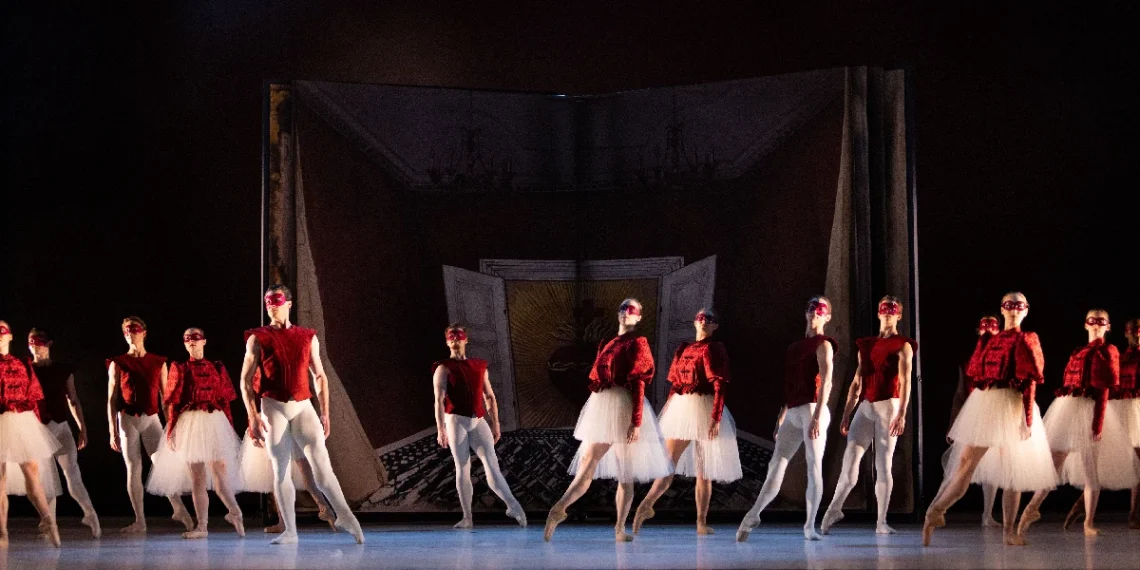
Costuming by Youssef Hotait deepens this effect further: Renaissance structure filtered through Victorian romanticism, deep velvets, soft pinks, tailored bodices, and silk like materials that respond to motion and light with liquid softness. Everything appears simultaneously historical and imagined, grounded and unreal.
But what makes the scene so devastating is how fragile that verticality is. The same bodies that appear weightless are fully dependent on structure, timing, and support. The celestial feeling is not escape, it is engineered suspension, and it cannot last.
Oksana Maslova’s Juliet begins to lose classical containment inside it. At one point her arms slip out of fifth during a supported turn, not as effect, but as breakdown inside partnering itself. She stops organizing movement and allows momentum to take over. Molina supports instability rather than correcting it; thus the duet reads as shared unraveling rather than fixed form.
Molina proves himself an extraordinary partner for Maslova, intuitive in timing, precise in response, and fully present to every shift in her body before it fully arrives.
But scenes like this do not survive on intuition alone. It takes control, trust, and absolute sensitivity to let choreography of this emotional magnitude unfold without resistance. This is not just a love scene, it is the love scene, carrying young love, surrender, terror, and ecstasy at once. Maslova’s Juliet becomes utterly, helplessly overtaken, her body yielding as if love itself has overtaken physical law.
That same intensity of relational chemistry extends beyond the lovers. One dynamic I find especially compelling, though easy to overlook in the rush of the tragedy, is the triangle between Romeo, Mercutio, and Benvolio.
Javier Rivet’s Benvolio is particularly striking here. His performance is beautifully calibrated, benevolent, clean-lined, and classically composed; he becomes the quiet stabilizing force within the trio. I have enjoyed watching Rivet over the past several seasons as his dancing has deepened in clarity and assurance, and here he brings a kind of moral steadiness that anchors the chaos around him.
Against him, Mercutio is all volatility, charming, clownish, unrestrained, larger than life, constantly testing the edges of the world he moves through. And Romeo sits between them, increasingly pulled toward intensity and rupture.
What makes this triangle so effective is how distinctly each dancer inhabits his center, yet how fluidly they respond to one another. The relationships feel lived in rather than constructed, and the contrast between restraint, mischief, and romantic extremity gives the early acts a kind of dangerous buoyancy before everything collapses.
Across the ensemble, physical specificity remains consistent.
Male roles carry volatility, humor, and aggression through precise articulation, attack, rebound, refusal, interruption. Juliet’s friends and the female ensemble provide contrast with buoyant classical phrasing, lifted timing, and a lightness that sharpens the world of the lovers rather than softening it.
The bridesmaids, in particular, quietly shape the world around Juliet with striking elegance. Their choreographic phrases are deceptively demanding, built on precise footwork, sustained coordination, and refined épaulement that require real technical control even as they appear effortless. What they offer is a distinctly classical femininity, ethereal, girlish, and luminous, yet never fragile in execution.
There is a shared breath among them that transforms the stage picture into something almost dreamlike, creating a visual lyricism that stands in contrast to the volatility of the men’s world.
In fact, the corps de ballet is where Nunes is most experimental. Classical geometry remains, but hierarchy shifts. Échappés open into second on flat feet, grounded rather than elevated (yes, I tried this at home). At first it feels unusual, then clarifying. There is something compelling in the way Nunes allows familiar classical vocabulary to tilt just slightly off-axis, never breaking form, but reweighting it.
I find myself drawn to these choreographic sequences that sit between clean classical ballet and what can only be described as a distinctly “Nunes” sensibility: angled, weighted, and rhythmically insistent.
The corps feels deeply grounded in plié, with a consistent emphasis on downbeats rather than lift or suspension, almost as if the choreography is listening more to percussion and brass than to the traditional upward pull of strings.
There is a real musical intelligence at work here.
Nunes has an ear for classical scores that feels unusually structural rather than decorative; he doesn’t simply set steps to music, he seems to think inside it, especially in registers that are often overlooked in ballet vocabulary.
His choreography frequently inhabits what isn’t typically foregrounded in the treble line: lower orchestral voices, rhythmic spine, harmonic weight. It gives the movement a sense of being anchored in sound rather than floating above it.
I’m starting to really appreciate how his choreographic language operates in this space – where classical ballet is not abandoned, but re-tuned.
What becomes clear over the course of the evening is that both Romeo and Juliet are constructed toward unraveling, not romance.
Romeo’s descent is physical before it is emotional, speed tipping into instability, attack replacing placement, weight increasingly thrown rather than held. Molina shapes him from a boy intoxicated by love into a young man overtaken by grief and rage. After Mercutio’s death, the transformation accelerates. You see it in the dancing itself, lines pitch forward, turns lose clarity, partnering becomes desperate rather than lyrical. The body stops reaching upward and starts driving outward.
The breaking point arrives in his revenge on Tybalt. Romeo drives the sword into Tybalt’s mouth in a moment that refuses refinement or aesthetic distance. It is brutal, impulsive, and startlingly literal. Later, in the crypt, when he strangles Paris, the physical language becomes feral, grief processed only through violence. Even here, the choreography remains exact. Collapse is embedded in vocabulary, not decoration.
By the time he carries Juliet’s body, form has fully given way to sustained collapse under weight and memory.
Juliet’s unraveling is structural rather than explosive. Maslova moves from classical clarity into gradual refusal of form, arms no longer held, turns losing center, partnering slipping from architecture into survival. The choreography stops organizing her, and sensation takes its place.
That trajectory is mirrored in the broader architecture of grief, and nowhere more searingly than in Natalie Patel’s Lady Capulet. Her presence accumulates slowly, until it becomes impossible to ignore. The grief is not immediate or decorative, it is drawn out, building weight in the body until it seems to exceed containment.
At one point, she is alone on stage, truly alone, as if the entire theatre has contracted into her isolation, and the effect is stunning in its simplicity. There is no excess gesture, no amplification of emotion beyond what is necessary. Just clarity, restraint, and pain allowed to fully register.
It becomes the first time I fully lock into her as a character in her own right, someone shaped by the same social machinery that produces the tragedy, and finally undone by it. The grief is simple, intense, and devastatingly human. It does not ask for attention, it takes it.
After the performance, I found myself talking with English horn player Evan Ocheret, Principal French Horn Todd Williams, and musician Elizabeth Jaffe about Prokofiev’s orchestral architecture.
The conversation kept circling its refusal of seamlessness. In contrast to John Williams, where musical lines merge into continuous cinematic flow, Prokofiev fractures continuity. Brass interrupts strings, winds cut across harmonic space, rhythmic ideas collide rather than blend. Structure is audible at all times, exposed rather than concealed.
What struck me most was how animated the musicians became describing it. The score is enormous, demanding, relentless, but also exhilarating to perform. This one is a treat, they said, without hesitation.
That same intensity seemed to extend across the entire production, dancers, musicians, and staging all working at full capacity, nothing held back.
In that convergence, something becomes clear: this Romeo and Juliet is not just tragedy staged, it is a system of coordinated pressure, where choreography and score push against each other until form begins to crack, and meaning emerges inside that fracture.
The final image remains direct. Oksana Maslova’s Juliet discovers Romeo’s body.
Nunes strips away stylization. The choreography reduces to physical response, collapse, recoil, sustained contact with the floor. Prokofiev continues without pause, and her body follows sound rather than resolving it.
The theater did not move immediately afterward. No one stood. The moment held the room in suspension. I hear the sniffles. Not a dry eye in my row.
Nunes and The Philadelphia Ballet nailed it.
After the performance, I went to buy a Romeo and Juliet t-shirt. They were sold out.
Outside, dancers still in costume and makeup moved slowly through the aftermath, some visibly in tears, as if the stage had not fully released them. One said, almost casually, that all of Philadelphia would find out tomorrow. And they did.
The next morning, The Philadelphia Inquirer announced that Beatrice Jona Affron would be moving on to New York City Ballet, closing a significant chapter marked by musical leadership and long collaboration with the Philadelphia Ballet Orchestra, an artistic presence defined by precision, consistency, and a deep responsiveness to live stage energy.
In that context, what Broad Street witnessed becomes clearer, orchestra, choreography, and company functioning as a single organism of pressure and release.
And still, the final image is the simplest.
Juliet finds Romeo’s body, and there is no choreography left to contain what follows.
Bravo. Like, seriously. Bra–vo.
Featured Photo of Artists of Philadelphia Ballet in Juliano Nunes’ Romeo and Juliet. Photo by Alexander Iziliaev.