L.A. Dance Project Romeo & Juliet Suite Review
March 18, 2026 | Park Avenue Armory – New York, NY, USA
Fortune’s fools, the star-crossed lovers Romeo and Juliet, are destined for doom just as William Shakespeare’s play is destined for retelling. It’s no surprise: we are addicted to the story’s high-stakes romance and dramatic irony, a literary technique where the audience knows what the characters do not.
The annual Dance Reflections Festival by Van Cleef & Arpels (an event worth earmarking for 2027) brought Benjamin Millepied’s Romeo & Juliet Suite, along with his company L.A. Dance Project, to NYC for a substantial 3-week run.
Millepied, who founded the West Coast troupe in 2012, also serves as its Artistic Director. His take on the bard’s play is a trim 80-minute distillation in brutalist simplicity.
You may also like...
In Dance, Francis Patrelle Review: Moving Forward, Without The Captain
Francis Patrelle, who devoted his life to telling stories through ballet, is honored in an in memoriam program assembled with affection.
Pacific Northwest Ballet Firebird Review: Contemporary Wins and a Classic Revisited
Pacific Northwest Ballet Firebird Review: PNB's spring program is a multi-faceted triple bill featuring three pieces of entirely different looks and sounds.
L.A. Dance Project Romeo & Juliet Suite Review
Sergei Prokofiev’s suite is the impetus for brevity, which strips away the narrative elements of the full-length. Simon Morrison, a music professor at Princeton University, explains in the program notes:
“The consensus is that the suites are an impoverished condensation of the ballet, but Prokofiev considered them a concentration… of the conflicts and struggles that define the principal characters’ existences.”
Besides the titular couple, Mercutio, Tybalt, and a small group to suggest crowded scenes, integral cast members (like the friar and Juliet’s parents) were absent.
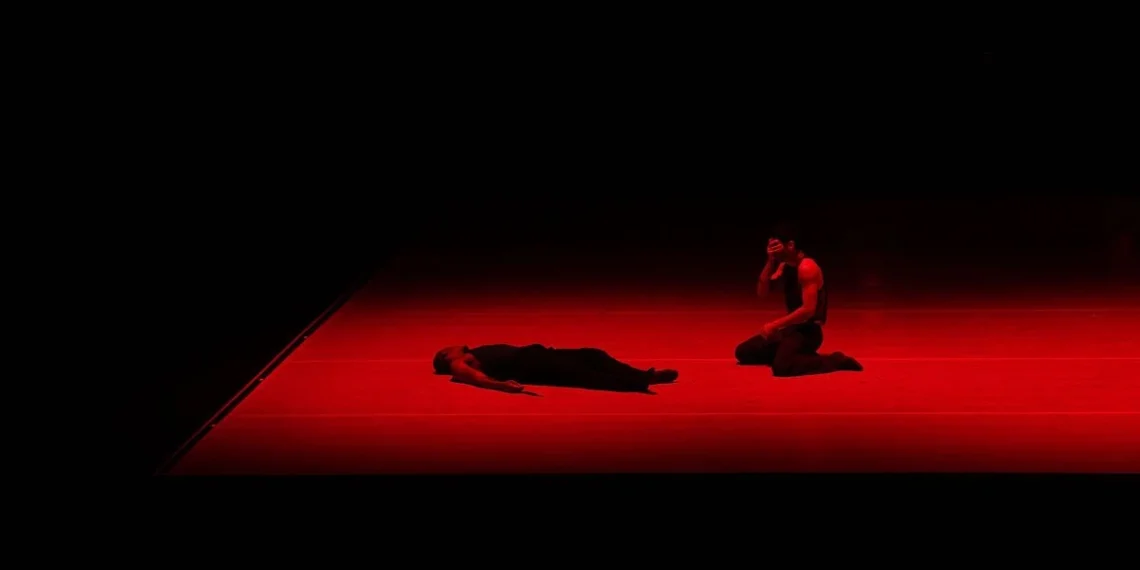
Similarly, the set is minimal, limited to the Park Avenue Armory’s gilded age interiors and designer François-Pierre Couture’s vivid lightsaber props. Camille Assaf’s costumes verge on alternative streetwear. A hanging cinema-sized screen and wide stage drenched in red light sit ominously inside the 55,000-square-foot drill hall.
The lack of narrative framework drops us into the middle of weighty emotions. It requires an agreement from the audience: we don’t need exposition to believe in the turmoil. In this case, though, we do.
Part of the cause lies in the music arrangement. For instance, Lord Capulet’s rage is deeply recognizable in the full-length score and imbued with meaning: he demands his daughter enter a high-status marriage. Here that phrase of music registers as general anger, lacking risk. How many times does an audience need to see Tybalt scowling?
Despite rejecting a classical approach, Millepied’s choreography has an ever-so-light touch of it with hands on hips and drooping, curved elbows evoking pastoral charm.
Millepied’s best work is when he pays special attention to the arms, tangled elbows and wrists evoke a sculptural quality, but most of the modern choreography is conservative.
Millepied and creative collaborator Olivier Simola scale up the drama by projecting intimate, off-stage moments onto the big screen via live cam. Tybalt’s death under the scaffolding of the audience seats and the lovers’ ardent first kiss on a lofty mezzanine were particularly successful.
Reflections are important too. As characters gazed into a multi-angled mirror, a lover or enemy is revealed in a distant reflection. It’s artistic and sleek but the clever cinematography couldn’t make up for the detached emotional conflict. The work is trapped in a repetitive stasis rather than a gathering storm.
Each show featured diverse casting: the lead couple could be portrayed in combinations of male/male, male/female, or female/female, with the character’s names retained despite gender swapping. It’s a fresh, inclusive, and honest tribute to love. The dancers tackle their roles with earnest passion.
On March 18th, David Adrian Freeland Jr. and Morgan Lugo danced Romeo and Juliet, respectively. Freeland is all poetry and spontaneity. His Romeo is always in a rush but careful to slow down for the tender moments. Lugo is wide-eyed and inquisitive yet brings a mature strength to his Juliet, passion expanding from ember to flame.
The camera operator, and perhaps the fifth principal role as fleet-footed shadow, is Sebastien Marcovici (Associate Artistic Director of L.A. Dance Project and former principal dancer with New York City Ballet).
Nimbly chasing dancers through corridors and secret back rooms, his cinematography exposed the opulent interior of the armory.
The aerial view of the stage was the only projection Marcovici didn’t, or couldn’t, cover. Canons in the group dances rippled twice over, horizontally and vertically. Every turn was both a tornado and spinning top.
The intermittent group dances would have benefited from more intricate patterns to enhance the multi-dimensional effect, but it was a sensory pleasure all the same.
At its creative height, Romeo & Juliet Suite is an adventurous, immersive experiment – no two venues would produce the same result – but too many motivational elements were eliminated. After all, violent delights have violent ends. Higher stakes would have yielded higher rewards in this star-crossed tale.
Featured Photo of L.A. Dance Project‘s David Adrian Freeland Jr and Morgan Lugo in Benjamin Millepied’s Romeo & Juliet Suite. Photo by Alex Sargent, courtesy of Park Avenue Armory.