Miami City Ballet ¡Vamos! To the Beach Review
May 1, 2026 | Adrienne Arsht Center – Miami, FL, USA
I flew into town for this one. When Miami City Ballet announced ¡Vamos! To the Beach: Spring Mix 2, I was genuinely thrilled.
The title alone, Vamos, a wink to Vamos a la playa, my hometown, the beach, the Beach Boys, Paul Taylor, Twyla Tharp, and a world premiere tucked neatly in the middle. The performance sounded like a love letter to Miami. A season finale with sun, sand, and style – I was all in.
And I will say this upfront. Whoever is in charge of marketing at the ballet deserves a raise. The campaign was stunning. Truly. But the lineup itself felt far weaker than the promise.
It suggested a vibrant, sun soaked, unforgettable finale, yet the reality did not quite meet that expectation.
You may also like...
Philadelphia Ballet Romeo and Juliet Review: A Masterpiece of Prokofiev, Juliano Nunes, and a Company at Full Power
Philadelphia Ballet Romeo and Juliet Review: This production understands that Shakespeare's tragedy does not survive on romance alone.
Pacific Northwest Ballet Giselle Review: A Classical Rewind
Pacific Northwest Ballet Giselle Review: The company's production was both well-danced and characterful, a welcome reminder of what its artists can do.
Miami City Ballet ¡Vamos! To the Beach Review
The program unfolded as a three part repertory evening. Paul Taylor’s Company B opened the night, followed by Durante Verzola’s world premiere Grand Glittering Gershwin, and closing with Twyla Tharp’s Deuce Coupe.
There was no purely classical score anchoring the evening. No Tchaikovsky, no Prokofiev. Just an all American musical arc: The Andrews Sisters, George Gershwin, and The Beach Boys.
Conceptually, it reads like a breezy summer mixtape. In execution, it felt more uneven than curated.
Company B leaned fully into nostalgia: Swing-era Americana, dreamy sailor boys, and bright-eyed, boy-crazy girls. It had charm, certainly, with moments of sweetness and even wit.
Chase Swatosh stood out in “Boogie Woogie Bugle Boy”, bringing clarity, attack, and potent artistry to the choreography. But after what felt like the tenth Andrews Sisters track, I found myself quietly wondering if we might move along.
Company B originally premiered in 1995, making it dated-contemporary. Audiences have evolved. Both ballet and popular music have long since moved stylistically forward from G.I. Generation. In that sense, the aesthetic here can feel a bit behind the present moment, rendering the choice less fresh than it might once have been.
Then came the evening’s strongest offering: the Gershwin premiere.
Grand Glittering Gershwin was, frankly, a relief.
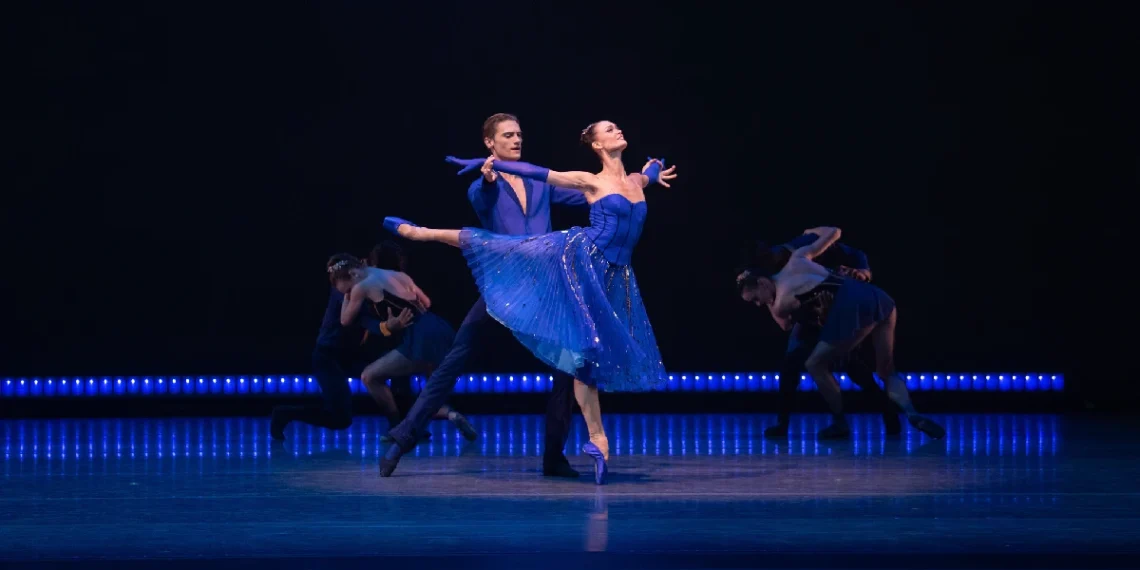
Structured in three defined, albeit non-evocatively titled, sections – “Allegro”, “Adagio (Andante con moto)”, and “Allegro agitato”, – it brought an athleticism and vibrancy that had been missing. Five couples, a trio, and a small female ensemble filled the stage with buoyancy and speed.
There was a distinctly American quality to the movement. Spunky, alive, lifted through the jumps, articulate through the wrists and arms. It felt closer to the kinetic energy of New York City Ballet, and for a moment, the company seemed fully switched on.
And then, Deuce Coupe.
Twyla Tharp. Beach Boys. On paper, this should have been a party. In reality, it never quite ignited. The structure, contemporary dancers moving alongside a lone ballerina in white, suggested an interesting tension, but if there was a narrative arc, I did not find it.
And the music choices? Deep cuts. For a reason. If you are selling a beach party, you might consider starting with Surfin’ USA or Barbara Ann, something to actually get us there.
Here is the difficult part. Miami City Ballet fell short of what it is capable of. And this is not a talent issue.
The dancers are immensely skilled, easily on par with elite companies in the Northeast. They were not the problem; they were the saving grace.
But what I saw onstage felt like maybe 40 percent of their full artistic capacity. The artistic, choreographic, and stylistic choices did not showcase them at their best. It did not seem to challenge them. The programming felt conservative to the point of being unexciting, even unoriginal.
Paul Taylor and Twyla Tharp, in this context, felt dated. I say that with nostalgia and a tinge of melancholy. These are giants of American dance. But the choreography, as presented here, read as stale. The movement vocabulary felt basic, repetitive, and at times dreadfully boring. And that is a hard word to use for a company of this caliber, but it is the honest one.
Whatever edge or innovation these works once carried did not translate in this performance.
I also found myself wondering why this particular lineup was chosen at this particular moment.
Ballet, right now, is fighting for audiences, for patronage, for relevance. This is not the time to play it safe. This is the time to raise the bar.
Instead, the evening leaned heavily on works that, while historically significant, now feel overly familiar. Safe. Even “gringo,” at times, in a way that does not reflect the Miami of today.
Take Company B, for instance. There is a reason someone near me whispered, “Isn’t Paul Taylor supposed to be… innovative?” Yes; this work may have appealed to G.I. Generation patrons, but is hard to feel thrilled by something that reads more like a period piece than a living work.
Meanwhile, Grand Glittering Gershwin hinted at what could be. It had spark. It had risk. It had a sense of now. Which only made the rest of the program feel more out of step.
There was also a noticeable disconnect with the city itself.
I am deeply proud to be from Miami – one of the most extraordinary cities in the country, a place of dazzling energy, layered cultures, and constant motion.
You taste it in the cuisine, hear it in the constant rhythm of Spanish, and feel it in the pulse of Afro-Caribbean and Latin American cultures woven together. There is a spark here, an unmistakable attitude – bold, sensual, irreverent – that sets Miami apart and demands to be uplifted and celebrated. Its music, architecture, and lush, unruly landscape only deepen that sense of a place fully alive.
And yet, there was not enough diversity reflected onstage. Not enough risk. Not enough of that Miami electricity.
And I have to say it. This show is called ¡Vamos! To the Beach. Not one word of Spanish. Not one. In a city where Spanish is, for all intents and purposes, a primary language, that absence felt strange.
And maybe that is why this felt personal.
There was a time, the old days on Lincoln Road, when Miami City Ballet felt electric. When going to the ballet was part of the cultural bloodstream of this city. There was a sense of occasion, of edge, of something distinctly ours. You felt Miami in the work.
This performance did not quite take me back there.
The talent is still present, undeniably so. But the programming, the choices, and the vision reflect a real urgency for the Ballet to rise to meet the city they represent. Because Miami is vibrant, multilingual, textured, and alive with rhythm, contradiction and beauty.
If the company hopes to move into its next chapter, it will need to take bigger risks, make bolder artistic decisions, and fully unleash the dancers it already has.
Because Miami is alive. The ballet should be too.
Featured Photo of Miami City Ballet‘s Cameron Catazaro & Hannah Fischer in Durante Verzola’s Grand Glittering Gershwin. Photo by Ren Media.


I just left the performance of the Miami City Ballet “Vamos to the Beach” at the Broward Center for the Performing Arts. This review is spot on! I dreamed of being a ballerina when I was a child. I have long enjoyed going to the Miami City Ballet performances. I love to sing the praises of this talented company of ballet dancers and yet I was more than disappointed at this rather tedious performance. I agree that it was at times boring, seemed to go on far longer than necessary, and lacked enthusiasm and vitality. When it came time to acknowledge the performance, I (for the first time ever) politely clapped but refrained from joining the small number of the audience who were giving the show a standing ovation.
Truly, as the journalist stated, this is not the way to gain new followers. Good luck on improving the productions for the coming season.