

MOMIX ALICE Review
December 16, 2025 | The Joyce Theater – New York, NY, USA
Remaking a classic can be difficult, but not for MOMIX.
Even for those who never read Lewis Carroll’s book Alice In Wonderland, the ambitious run of Moses Pendleton’s ALICE at The Joyce Theater is a successful spinoff that can speak for itself.
Pendleton is not merely a choreographer but a master of creating total-theatre experiences. While dance stays in the foreground of his works, Pendleton understands that movement alone is not enough to fully realize his vivid imaginations. By MIXing dance, music, costumes, lighting, props, technology, magic, puppetry, film, carpentry, acrobatics, and other art forms holistically, his works often multiply in artistic impact.
Audiences are captivated by these total-theatre immersive experiences for which the company is known for, and it is no surprise that I found myself seated next to a man attending ALICE for the second time with his wife.
Performed without intermission, the enchanting performance unfolds through 22 whimsical vignettes, each reading like a chapter from Wonderland.
You may also like...
An Evening with Matthew Ball Review
An Evening with Matthew Ball was the first in a new series presented by Fundamentally Dance aimed at closing the intimacy gap between artist and audience.
BalletX New Voices Review: The Future of Ballet Is Pointing to BalletX
BalletX New Voices Review: "Igniting the Future of Dance" honors ballet’s rigor by pushing it forward and exploring fresh ideas that feel unmistakably of this moment.
MOMIX ALICE Review
Alice (Seah Hagan), dressed in white, sits atop a ladder suspended by strings, teeter-tottering as a man (Derek Elliott Jr.) behind her controls its rise and fall.
She glides across the stage in an arabesque, then walks on air like an elegant aerialist from a circus. Though the two dancers never make eye contact, Alice and the man (dressed like Lewis Carroll) danced with an inexplicable connection. In her hands rests a book titled ALICE, which at one point she held upside down, foreshadowing her world to come.
Strangely, multiple Alices appear out of nowhere to motion around four white warped pipes (think “Super Mario”) to music that resemble the soundtrack from Edward Scissorhands.
Another eerie but hilarious moment is when one of the three air-filled puppets suddenly extends its neck to rotate its head with flinging blond wig a full 360 degrees.
From these moments, I realized that Pendleton's brilliance lies in his playful design of ambivalence, creating scenes that evoke conflicting emotions, pairing the bizarre with the beautiful, and situating the weird with the wonderful.
He orchestrates amazing absurdities that ultimately come together in satisfying ways. The more ambivalent, the more intriguing… curiouser and curiouser, they say.
A group of dancers wearing rabbit masks then creeps onto the stage. Clad in nude-colored leotards, they snake through space as a tight colony, tilting their heads and locking their gaze on the audience without ever looking away.
Set to bell-like music, they shuffle and pulse athletically through the space; one lightheartedly sautés, another tries to break from the group before being tugged back into the pack.
Down the rabbit hole they go, a cheeky reminder of how joyful it can be to dance like animals.
Next, the most bizarre tableau (that still haunts me today) begins with a dancer slithering onstage wearing a giant cardboard cutout of a smiling baby – pursed lips and all -pasted over her head and neck, as if an infant is dancing in an adult body (and whose baby is this?)
The music blends Indian folk influences with techno beats, increasing its surreal aesthetic. Another dancer soon enters wearing a duplicate baby face, followed later by two more dancers bearing frowning versions of the image.
Together, the quartet launches into a series of unexpected movements: flossing out a trendy TikTok move, planking, taking turns lifting one another, and even attempting to dance arm-in-arm in a playful nod to The Four Little Swans.
As they exit, the audience is left laughing and wondering: what the heck just happened?
The strongest choreographic portion of the evening showcases Pendleton’s mastery of props.
Three women and three men, dressed in running suits and red tennis shoes, embody a caterpillar by holding six blue exercise balls (though green would have been… better). Set to high-energy techno music, at one point, they bounce the balls in a group circle, some even managing to fit in pas de deux between the bouncings.
Seated atop the balls, the dancers rippled their arms forward and sideways in a diagonal canon. This sequence reveals an unexpected calm and aligns perfectly with the music. Overall, I felt as though Pendleton went to the gym and had a little too much fun choreographing after a workout in the Pilates room.
I also appreciated the way Alice was briefly woven into the center of the dance, running through the caterpillar to keep the narrative alive.
The choreography demands athleticism and precision, and thankfully no one dropped the literal and metaphorical ball.
Another standout moment in the show was when four women enter wearing what appear at first to be black and red lampshades. It is in this section that the full impact of total-theatre collaboration truly comes to life.
The highlight here is the inventive usage of costumes (credit is due to Phoebe Katzin and Beryl Taylor), whose multipurpose gowns are nothing short of sheer genius.
Drawings of lobsters (by Woodrow F. Dick III) fills the backdrop, momentarily making me fantasize about an elegant seafood dinner after the show.
The lampshades begin to morph: first into enchanting gowns with black bodices, then spinning into new forms like Valentino meets Cirque du Soleil. The costumes transform again, this time gala gowns shift into black-tie silhouettes, and then suggestive echoes of “Little Red Riding Hood” as the music murmurs, “miss you.”
As the dance continues, the women seem to become lobsters, playfully manipulating layers of fabric. The red dresses reconfigure into sculptural headpieces, ultimately resembling flowing hair. Later, they returned to glide around like Berezka folk dancers, and overall this vignette is an imaginative, fluid, and elegant demonstration of how costume, movement, and projection can merge into a single, mesmerizing theatrical vision.
ALICE draws from an extraordinary range of dance styles: salsa, aerial dance, pointe, modern, contemporary, gymnastics, breakdancing, acrobatics, contact improvisation, and dance theatre. It demands dancers with extreme physicality and skills to pull off.
Aside from the aforementioned, there were so many memorable moments in ALICE.
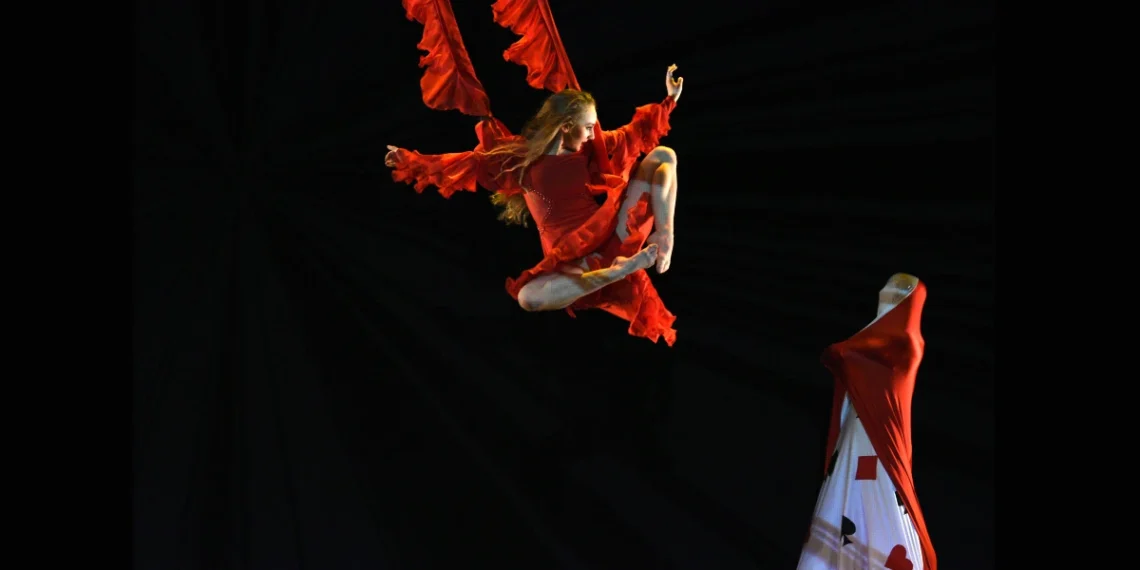
When an aerial dancer (Hagan, again) ignites the stage with a fiery salsa-gymnastics number, battu-ing her legs midair as she executes feats that could only be achieved on aerial straps.
When the Queen of Spades (Heather Conn) makes her entrance, standing atop two men’s backs while they swim through space on scooters. Conn stood out with undeniable star quality, fully inhabiting each character and serving as the glue that holds the ensemble’s ebb and flow.
When the four Alices weave through the portable mirrors that rolled around in intricate patterns, it further showcased how Pendleton can transform everyday objects into mesmerizing tools for dance.
When two men partnered two women into acrobatic lifts that resembled tree branches in jungle-inspired techno.
When dancers move in stretchy fabric, forming cross shapes, genuflecting in stained-glass window projections, reminiscent of the purple one from Martha Graham’s Lamentations.
And when the Alices returned to dance “A Bed of Roses”, my heart bloomed.
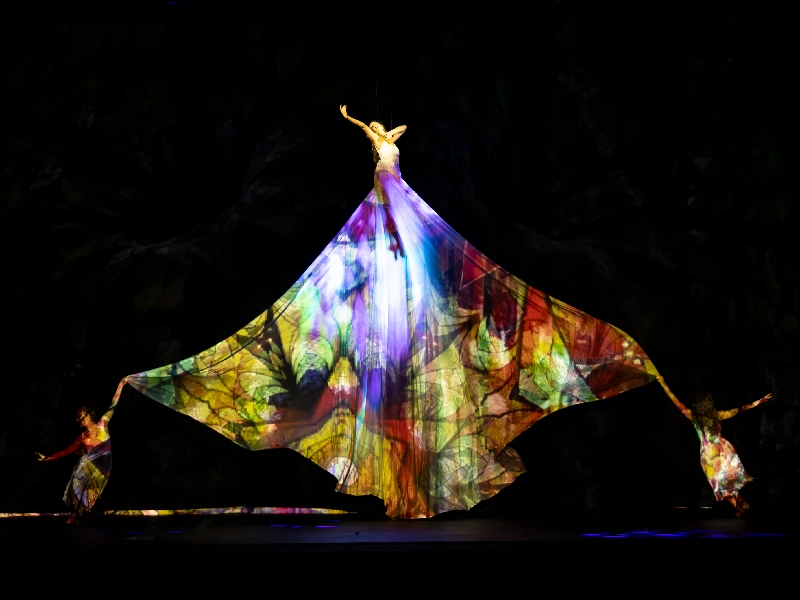
The curtain lifts for the last time, revealing Hagan’s Alice in an opal-colored gown, resembling an angel mushrooming to the sky. Two dancers grasp the edges of her iridescent dress and start to spin her like a merry-go-round. It is an inspiring moment, the show saving its strongest vignette for last, ending in a memorable transfixing ascension.
Experience is by far the best teacher. If you are in New York, I recommend making a pitstop at The Joyce and educating yourselves about ALICE, running through January 4, 2026.
Be prepared to rise for a standing ovation and enjoy the dance-illusionists’ playful lingering bow. Meanwhile, may this review help you ascend into a shimmering New Year.
Featured Photo of MOMIX‘s Seah Hagan as Alice in Moses Pendleton’s ALICE. Photo by Equilibre Monaco.