Dutch National Ballet Program A Review
November 20, 2025 | New York City Center – New York, NY, USA
Live music is the gilding on the frame of dance. Yes, a painting can still be beautiful without the filigree of live sound but something about real musicians in the room makes the art feel more alive.
On Dutch National Ballet’s Program A at New York City Center, live music was one of the few elements that landed. Despite the works with accompaniment being the strongest, they were still overshadowed by a disjointed program.
You may also like...
Pacific Northwest Ballet In The Upper Room Review: Of Contrasts and Connection
Pacific Northwest Ballet In The Upper Room Review: A program that moves from dystopian drama through intimate observation to communal celebration.
BalletX 20th Anniversary Retrospective Review: The Red Shoes of Ballet
In the BalletX 20th Anniversary Retrospective, each snippet is concentrated - a burst of energy and artistry so lush and thrilling you can almost taste it.
Dutch National Ballet Program A Review
Wubkje Kuindersma’s limerence-fueled Two and Only was accompanied by musician Michael Benjamin, a deep, crooning voice who added depth with guitar and piano. Dancers Timothy Van Poucke and Conor Walmsley mirror intense longing in a duet bathed in a pool of designer Bert Dalhuysen’s dramatic lighting.
Kuindersma’s vocabulary is thoughtful. Palms thread through negative space and limbs stretch into expansive arcs, which the duo illustrates with electric, full-bodied movement. The effect is a duet ripe with dramatic tension, although dulled by the occasional on-the-nose reference to the lyrics.
Other Dances is an exceptional work for both viewing and listening. Created by Jerome Robbins in 1976 for Natalia Makarova and Mikhail Baryshnikov, the work pays reverence to the composer Frederic Chopin’s classical purity and the refined technique of the Russian dancers.
Robbins’ commentary on the imperial style is reflected in precisely placed hands on hips, elbows jutting sideways to emulate folk dancing, and light step-brush-hops of the mazurka.
Having premiered at the Metropolitan Opera House, the piece is no stranger to New York City which makes it an interesting choice for Dutch National Ballet’s return to New York City Center.
Olga Smirnova and Jacopo Tissi, who both left the Bolshoi Ballet in 2022 in the wake of Russia’s invasion of Ukraine, danced the pas de deux.
He was a devoted partner who shared sweet chemistry with Smirnova, but she shone like a Fabergé egg; delicate, regal, a touch of mystery.
The tender placement of her hands, weightless elbows, and unfettered flirtation with Ryoko Kondo’s playing reignited the work’s original imperial roots. However, its inclusion felt incongruous; plucked from obscurity and dropped into a dense program.
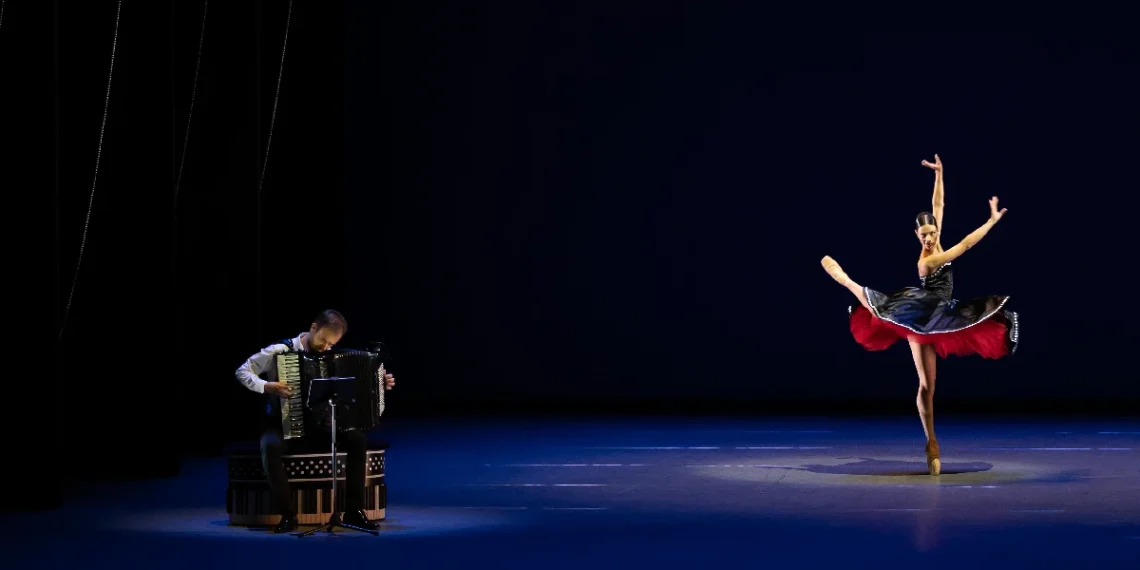
Perhaps the most musically curious was Alexei Ratmansky’s Trio Kagel set to Mauricio Kagel’s endearing and bizarre accordion music played by Vincent Van Amsterdam. The work is abstract, echoing the wheezes of the instrument and infused with Ratmansky’s physically demanding vocabulary and cheeky sense of humor.
To contrast the whimsy, the piece is doused in realism, though only superficially. The accordion player sits on a stool of painted keys, the wings are adorned in jewels, and Keso Dekker’s costumes evoke mid-century circus.
Ratmansky has a knack for unsuspecting yet absurd choreography: dancers drop to the ground, park their chin on their fist, or crawl offstage.
The pace is fast and the shapes challenging but this work, of all on the program, best showcases the technique of the Dutch National Ballet dancers.
Giorgi Potskhishvili is a kinetic force and drove the house mad after an impressive bravura solo. Lore Zonderman and Kira Hilli dance with fierce exactitude, their lines crystal clear and humor polished.
Outside of the works with live music, the audience had to trudge through an opening and closer in which both forgot to feature the dancers’ strengths.
The Chairman Dances by Artistic Director Ted Brandsen, to music of the same name by John Adams, featured large group work and metronomic shoulders. Steeped in symmetry, both visually and in the arc of the piece, this work ultimately lacked texture and direction.
The closer, Frank Bridge Variations by Hans Van Manen was the bigger let down. The previous works’ fragmented lineup amplified anticipation for a substantial closer, but Manen’s botoxed choreography fell flat against Benjamin Britten’s musically rich score. Long interludes of slow walks in unimaginative formations and splayed legs left this work in the year it was created, 2005.
While it’s commendable to bring nine works on tour (across programs A and B), something was lost along the way.
Featured Photo of Vincent Van Amsterdam on the accordion accompanying Dutch National Ballet dancer Lore Zonderman in Alexei Ratmansky’s Trio Kagel. Photo © Nina Tonoli, courtesy of New York City Center.