Pacific Northwest Ballet Jewels Review
October 13, 2025 | Digital
The law of diminishing marginal utility is an economic concept that, loosely defined, explains the gradual loss of satisfaction over repeated encounters. The fifth time you read your favorite book, for instance, may not move you as greatly as the first.
Of course there are exceptions, not the least of which is George Balanchine’s landmark triptych Jewels.
At the McCaw Hall stage on September 26, Pacific Northwest Ballet kicked off its 53rd season with an assured crowd-pleaser, a ballet that has dazzled audiences since its premiere in 1967 (since 2006 for PNB audiences). This year was no exception.
You may also like...
Joburg Ballet Communion of Light Review: Connection Even in Darkness
Despite the company's spirit of hope and creativity, Joburg Ballet touched on some rather dark and heavy themes in Communion of Light.
Turn It Out With Tiler Peck & Friends Review: A Prima, Making It All Happen
As curator of Turn It Out With Tiler Peck & Friends - and together with her stellar retinue - Peck puts on a show that not only inspires but also proclaims how she is setting a new standard in the...
Pacific Northwest Ballet Jewels Review
Jewels, a specious motif carried out strictly in variegated costume design, is a suite of three distinct, plotless ballets. Revolutionary in its day, it is pure and simply lovely dancing set to beautiful music. Hardly discrete, however, is its historical edge, with each ballet drawing inspiration from a distinct ballet tradition.
The program starts with Emeralds, which, set to a rich, romantic score by Gabriel Fauré, evokes the demure elegance of 19th-century French Romanticism. Point blank, this is a notoriously difficult ballet to perform well. Though there was much to admire in this rendition, it didn’t play to the strengths of PNB as well as its succeeding pieces.
While the company, outfitted in gorgeous absinthe-colored costumes designed by Jérôme Kaplan, nailed each step with impressive exactitude and striking synchrony, a little more abandon could have made all the difference.
This was particularly the case in Amanda Morgan’s solo which, while technically correct, came across as too calculated and a bit awkward. Even principal Elizabeth Murphy and soloist Christopher D’Ariano allowed a few sections to elapse before sinking into the unrestrained delicacy that gives this piece its intended gossamer effect.
But where Emeralds fell short, the second movement more than delivered.
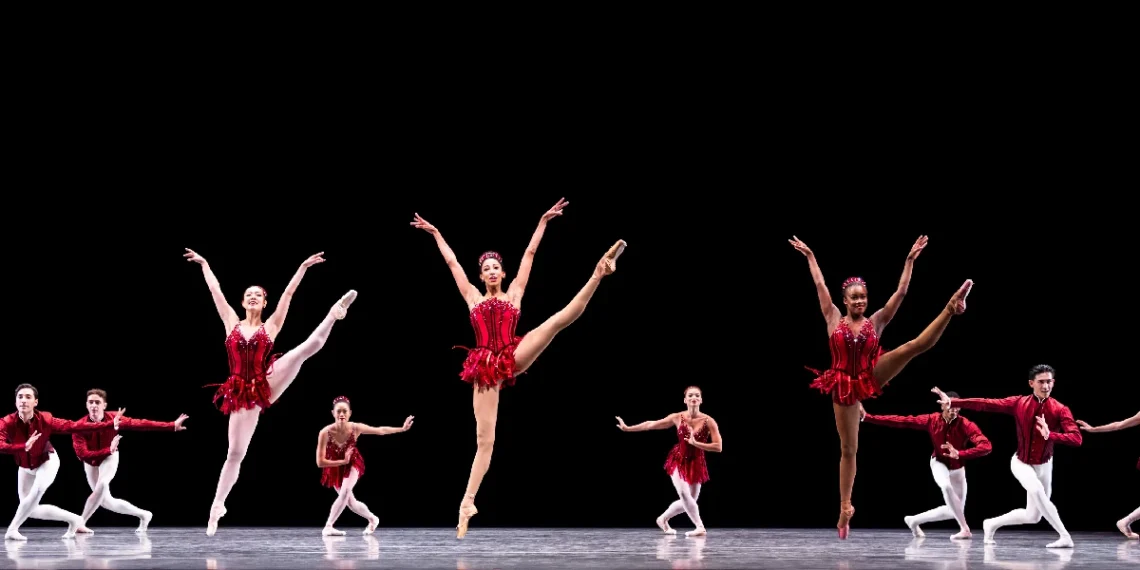
A nod to 20th-century American neoclassicism (the very tradition on which Pacific Northwest Ballet was founded), Rubies fell squarely within PNB’s wheelhouse.
The company blazed in the Balanchine-style blend of balletic lyricism and playful, jazzy movement, underpinned by Igor Stravinsky’s energetic score. Yet none shone more brightly than Morgan who, flicking her limbs into impossible geometry, delivered all the full-hearted commitment to her central role in Rubies that had been absent in her earlier performance.
Taking on the main pas de deux, Angelica Generosa and Jonathan Batista were an absolute delight to watch. The choreography, characterized by quicksilver footwork and teasing exchanges, seemed tailor-made for the pair.
Generosa danced with her usual verve and confidence, her movements somehow incisive yet decadently smooth. Batista was all command and charisma.
The real joy, though, was in the details – a raised brow, a lingering glance, the sharp flick of a wrist, small gestures that shaped the piece’s arch mood.
The program concluded with Diamonds, a sublime reflection on the 19th-century Russian imperial classicist world Balanchine grew up in. Set to Pyotr Ilyich Tchaikovsky’s Symphony No. 3, Diamonds showcased PNB at its very best.
Leta Biasucci and Lucien Postlewaite, who is celebrating his final season, helmed the ballet strongly in the principal pas de deux. They danced as if gliding atop a crystal stage, each movement effortless and precise.
Biasucci’s calm, almost unnervingly stoic countenance, an expression only possible with her experience and technical mastery, gave her performance a dreamlike quality. Postlewaite, matching her brilliance, was the perfect cavalier executing the kind of suspended leaps and unshakable turns that make you hold your breath.
The company, whose blush-colored dress evoked more of a Degas painting than a diamond, danced fearlessly and near-faultlessly, maintaining a level of razor-sharp synchrony of true classical ballet.
What made Jewels such a splendid season opener was the way it tested Pacific Northwest Ballet’s range, proving the company’s broad aptitude and making a strong case for the ballet’s continued presentation.
Featured Photo of Pacific Northwest Ballet soloist Amanda Morgan (center) with company dancers in Rubies from Jewels, choreography by George Balanchine © The George Balanchine Trust. Photo © Angela Sterling.